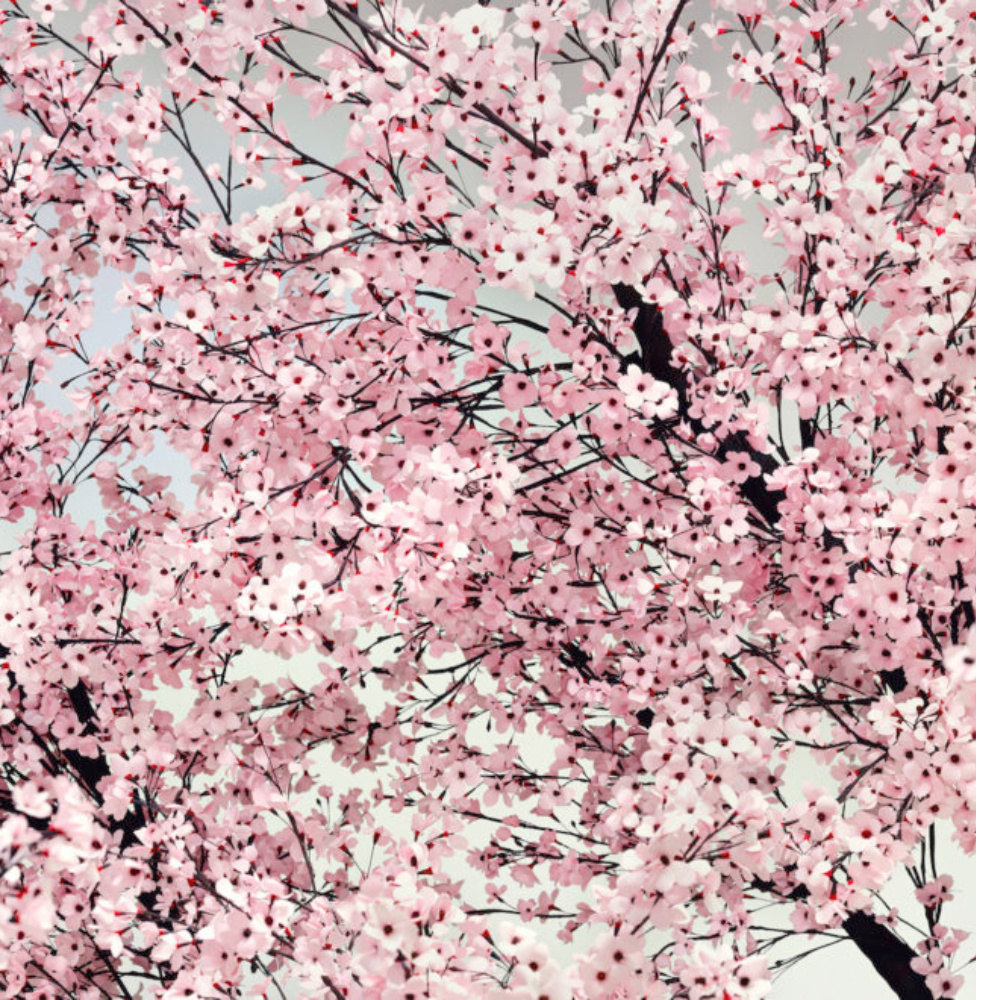
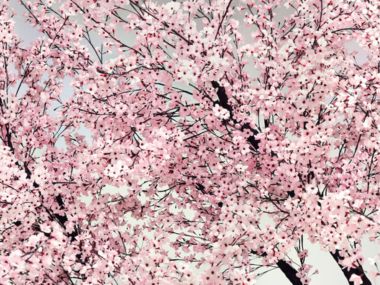
 Thomas Demand. Hanami, 2014
"Thomas Demand. The stutter of history"
by Adriana Rosenberg
Thomas Demand’s images evoke a strange sense of familiarity. We are confronted with spaces and situations that seem to belong to a shared memory, yet something within them remains elusive. There are no people; the details that might help orient us have disappeared, and absence becomes a constitutive element of the image. We know—or sense—that something has happened, but nothing allows us to fully uncover it.
The Stutter of History presents an extensive survey of Thomas Demand’s work and an artistic practice that brings together, in a singular way, two fundamental dimensions of photography: its status as a document and its capacity for creation.
Demand frequently works from photographs published in the media and other images, almost always connected to political, social, and cultural events that have circulated publicly. He does not reproduce them. Instead, he uses them as a point of departure to reconstruct the depicted spaces at full scale in paper and cardboard. These temporary constructions are made for the sole purpose of photographing them from the same viewpoints as the original images, after which they are destroyed. The resulting photograph is the final outcome of a succession of transformations. Although it retains the details of a significant event, it is no longer a direct record of it. Throughout Demand’s work, history and memory emerge not as complete and stable narratives, but as structures marked by omissions and gaps.
These gaps are also the space Demand reserves for the viewer. Contemplation ceases to be a passive act of observation and becomes a form of action. By removing names, texts, people, and many of the references that would allow the event to be reconstructed, the work calls for active participation. Looking entails searching for clues, establishing associations, remembering, imagining, and completing what the image deliberately withholds. Each viewer must draw on their own memory, knowledge, and experience.
Presenting The Stutter of History in Buenos Aires offers an opportunity to engage with a body of work in which photography, sculpture, documentation, and creation intersect, and in which the events of the past—transformed by time and by the artist’s gaze—acquire an unsettling presence. In a world shaped by the ceaseless circulation of images and the advance of artificial intelligence, Demand proposes something apparently simple yet deeply challenging: to pause, look closely, and ask ourselves once again what we truly know about what lies before our eyes.
Fundación Proa extends its special thanks to the Foundation for the Exhibition of Photography (FEP), whose collaboration made the presentation of this exhibition in Buenos Aires possible; to Thomas Demand, for his generous participation and commitment to the project; and to Douglas Fogle, curator of the exhibition, for his work and continued support. We also thank the Fundación Proa teams who contributed to the realization of the exhibition, and offer special recognition to Tenaris, Ternium, and Tecpetrol, the longstanding sponsors of our program, whose sustained support makes the development of our projects possible.
Introduction to the Exhibition
by curator Douglas Fogle
What is it that we actually see when we look at Thomas Demand’s photographs? Demand, born in Munich in 1964, has spent almost three decades exploring the intersections of history, images, and built forms. In his large-scale photographic objects, history presents itself as banal, gnawingly disturbing facsimiles of places and episodes that we cannot quite identify. While appearing to depict the real world, the images’ similitude is fragile: these are in fact photographs of impermanent sculptural recreations. Demand selects images from the media, recreates them as life-size models using paper and cardboard, and then photographs them. The key to his work is understanding this loop: from the actual events, through their photographic record in the media, to Demand’s sculptural recreations and his uncanny para-photographic versions that are launched back into the world.
Before completing his MFA at Goldsmiths College, Demand studied at the Kunstakademie Düsseldorf with sculptor Fritz Schwegler, who encouraged him to explore the expressive possibilities of models. He originally took up photography as a way to document his ephemeral paper reconstructions of everyday objects, but soon these meticulous constructions were being made solely in order to be photographed. This became the basis of his artistic practice. After photographing his models, he destroys them, leaving behind only the ghostly photographic double. The stutter of history lies in that strange gap between the world we inhabit and the recreated world of paper and cardboard the artist conjures in his studio.
“Thomas Demand: The Stutter of History” presents a career-wide survey of important areas of Demand’s work. His Uncanny Histories are large-scale photographs of anonymous yet historically significant scenarios. These, like his entire practice, manifest his engagement with collective and personal memory, as well as with issues of originality, reproduction, craft, and materiality. The smaller-scale Dailies are constructed from images taken with his phone that investigate the mysteries of everyday life. Demand’s fascination with architectonic forms is evident in Model Studies, which document paper maquettes created by architects and dress patterns cut by fashion designers, and in his use of wallpapers of his own design. His commitment to the moving image comes to the fore in two mesmerizing explorations of stop-motion filmmaking.
Thomas Demand has also conceived the design for the exhibition, as an integral part of his approach to artistic production. With his architectural use of wallpapers and temporary structures, he creates an immersive environment for the viewer in which image and world collide.
"Thomas Demand: The Stutter of History" is curated by Douglas Fogle for the Foundation for the Exhibition of Photography (FEP), Minneapolis/Paris/Lausanne, in collaboration with Fundación Proa.
__
Douglas Fogle
Douglas Fogle is a Los Angeles-based curator and writer with more than twenty years of experience at three major American institutions (Walker Art Center, Minneapolis; Carnegie Museum of Art, Pittsburgh and Hammer Museum, Los Angeles). His most recent exhibition, “Andy Warhol: Dark Star”, opened at Museo Jumex in June 2017. From 2009 to 2012, he served as Deputy Director of Exhibitions and Programs and Chief Curator at the Hammer Museum in Los Angeles, where he organized a variety of exhibitions including “Ed Ruscha: On the Road” (2011), “Mark Manders: Parallel Occurrences/Documented Assignments” (2010) and “Luisa Lambri: Being there” (2010). Previously, he served as curator of contemporary art at the Carnegie Museum of Art in Pittsburgh from 2005 to 2009, where he organized “Life on Mars”, the 55th Carnegie International in 2008. Prior to that, Fogle was a curator in the Visual Arts Department at the Walker Art Center in Minneapolis from 1994 to 2005, where he curated exhibitions such as “Painting at the Edge of the World” (2001), “The Last Picture Show: Artists Using Photography 1960-1982” (2003) and “Catherine Opie: Skyways and Ice Houses” (2002). As a writer, he has contributed to numerous periodicals and exhibition catalogues for artists such as Leonor Antunes, Irma Blank, Dirk Braeckman and Luisa Lambri.
INTERVIEW | ADRIANA ROSENBERG
By Proa’s Press Department.
How did the relationship with FEP (Foundation for the Exhibition of Photography) come about, and what other projects have you carried out or are planning to develop together?
This is the first time we have worked with FEP, and we find it to be an institution of enormous interest. Looking through its exhibition catalogue, we were able to appreciate its remarkable engagement with contemporary art through some of the most notable artists of the twentieth century and today. It is a pleasure for us to establish contact with the institution and to begin a relationship that, I believe, opens up new possibilities for exhibitions, exchanges, and collaborations with leading international artists. We also hope that, with the arrival of its founder, Todd Brandow, he will have the opportunity to become more closely acquainted with the work of Argentine photographers and the enormous potential that exists in our country, and that this relationship may contribute to bringing some of them greater international visibility.
What new discussion does this exhibition introduce into the trajectory Proa has been developing around photography, from the exhibitions of Grete Stern and Horacio Coppola, through the photographers of the Düsseldorf School, to the present day?
Over the course of three decades, we have highlighted the work of emblematic photographers such as Christiano Junior, and among our earliest exhibitions we presented the work of Benito Panunzi, who produced one of the first systematic photographic surveys of the city of Buenos Aires. We also collaborated on the recovery of photographic archives through projects carried out at the time with Fundación Antorchas. We have included contemporary artists and photographers in many group exhibitions as well as in solo presentations, among them Sebastião Salgado, in one of our most important exhibitions devoted to photography. Urban Spaces featured artists who belong to the generation preceding Thomas Demand. The Düsseldorf School exhibition had an enormous impact, not only because of its influence on international photographic production but also because of its contributions to contemporary theories of the image. Today, with Demand, we continue along this path, broadening it and introducing new perspectives.
In Demand’s work, the photograph we see is the result of a sculpture that no longer exists: the work is constructed in order to be photographed and then destroyed. What does this process suggest about the idea of the artwork as a unique, material, and permanent object?
In fact, a photograph is not necessarily a unique work: there are generally proofs, several shots of the same scene, and an edition. In other words, photography does not belong to the category of uniqueness or of the singular object. And, in many cases, neither does sculpture: there is almost always a sketch, and different editions can be produced. In that sense, it seems to me that in Demand’s artistic practice, the concept of the unique, permanent object is already called into question by the very disciplines he works with, both sculpture and photography.
Demand makes the process more complex because he constructs a sculpture that is intended to disappear, and whose existence we come to know through the photograph. But it is not a matter of one discipline replacing the other; rather, both are part of the work. The sculpture is unique but temporary; the photograph remains. That tension calls the idea of the unique artwork into question and makes it one of the central themes of his artistic process.
If we consider the changes and transformations of the photographic image from Proa’s earliest exhibitions to this retrospective, what reflections does the current state of the image prompt, and how does Demand’s work challenge what we have seen, looked at, and absorbed into our collective imagination over all these years?
I do not think Demand’s work challenges the history of photography itself. From its origins, photography was closely associated with its documentary function, and throughout its history the photographer’s individual vision and creative agency have become increasingly significant. What I find particularly distinctive in Demand’s work is precisely the way he brings these two dimensions together.
He works from documentary photographs, often drawn from the press, that record real events, but he does not reproduce them. Instead, he uses them as a starting point to reconstruct those scenes and create a new image. In this way, Demand brings together within a single work two fundamental dimensions in the history of photography: its documentary nature and the artist’s own perspective. The image preserves the memory of an event, while at the same time being the result of a reconstruction and an artistic decision.
I believe that this ability to bring together documentation and creation, while incorporating the concepts of history and memory into that relationship, is one of the qualities that makes Demand’s work distinctive among the artists we have presented at Proa.
The artist works with images connected to events that have already become part of our collective memory. What relationship do you see between this conception of history and the way we experience events today through screens, headlines, and social media?
It seems to me that one of Demand’s most interesting contributions lies in the role assigned to the viewer. The works he presents contain the memory of a historical event, but the absence of information, references, or clues that would allow us to reconstruct it means that the viewer has to take an active role in relation to the work.
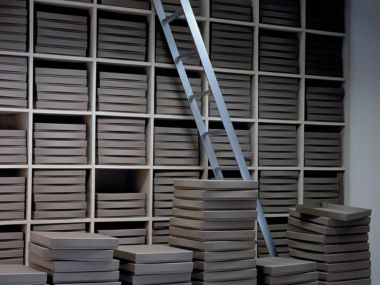
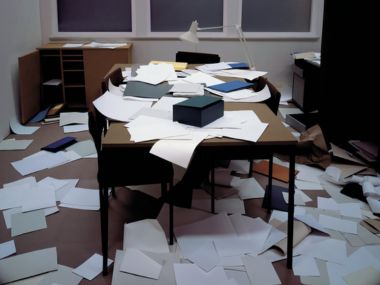
For example, in the image of the archive boxes, the absence of information indicating what they contain means that the viewer must, in a sense, fill those boxes with their own references. The same thing happens in those violent office scenes, with files and papers destroyed or scattered around: we know or sense that something happened there, but Demand has removed the information that would allow us to fully reconstruct the event.
I think that this absence operates, on the one hand, as a kind of knowing gesture, because we are looking at an image that we somehow believe we recognize or that forms part of a collective memory. At the same time, however, the viewer has to fill that absence with content drawn from their own memory and experience.
In this sense, Demand disrupts the traditional relationship between subject and object, between viewer and artwork. Contemplation is no longer simply an act of observation; it becomes an action. In the absence of information, looking means completing, associating, remembering, and reconstructing. The work is therefore not presented as a closed image, but rather as a construction that is completed differently through each viewer’s experience.
With three leading figures in the international photography world—Todd Brandow, Douglas Fogle, and Thomas Demand—coming to Buenos Aires, and given the relevance of the subject today, what will the Public Programs offer?
To begin with, a few days before the exhibition opens, we are fortunate to have all three guests in Buenos Aires at the same time for the first session of our Encounters for Reflection series. It will be a very special event with Thomas Demand; Todd Brandow, Director of the Foundation for the Exhibition of Photography (FEP); and Douglas Fogle, curator of the exhibition. It is a unique opportunity to hear directly from the artist and to situate his practice within the broader context of contemporary photography and visual culture.
Over the coming months, the program will expand on these themes through special exhibition tours with artists and critics, further Encounters for Reflection, as well as a film series and other programs that explore the issues running through the exhibition: the construction of images, contemporary visual culture, memory, and the ways in which we relate to what we see. These activities are complemented by Proa’s educational programs, designed for a wide range of audiences.
The idea is that the exhibition should not be exhausted in a single visit, but that each of these programs should open up new ways of entering Demand’s universe and thinking about the images that form part of our everyday lives.
Works
Gallery 1
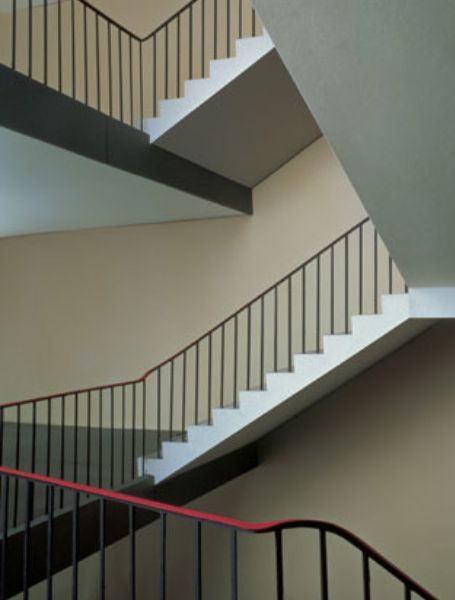
Treppenhaus / Escalera, 1995
In Treppenhaus / Staircase (1995), Demand drew on his own memories—in this case, of the staircase at the school he attended—to construct a three-dimensional model on paper. Together with Sprungturm / Diving Board, these works give shape to memories of architectural spaces he experienced first hand and, at the same time, connect with two diametrically opposed visual cultures: on one hand that of German fascism and on the other the utopian design aspirations of the Bauhaus followers, many of whom fled Germany to escape the tyranny of the former.
The detail of the red banister rising to the top of the image evokes the philosophy of the Bauhaus school, in which ‘form follows function’, and, more specifically, legendary staircases such as the one created by Mies van der Rohe—a former Bauhaus member—for the Arts Club of Chicago (1948–1951).
These two early works by Demand establish a dialogue between personal and collective memory, and reveal the power of images when the two intertwine. It is impossible to separate these historical interpretations from the artist’s deeply personal memories.
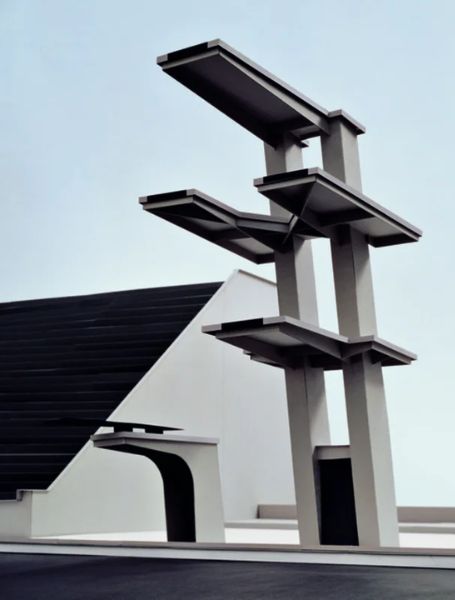
Sprungturm, 1994
While finishing his postgraduate studies, Demand conceived what might be considered his first mature work. Sprungturm / Diving Board (1994) was created solely from the artist’s memory of the swimming pool in which he learned to swim as a child.
When it was first exhibited, the work provoked reactions that linked its imagery to Nazi Germany, the 1936 Berlin Olympic Games and, specifically, to the famous diving sequence from Olympia (1938), Leni Riefenstahl’s legendary documentary. Demand was fully aware that the work could evoke these associations, particularly as it was being presented at the Haus der Kunst, a building originally constructed by the Nazi regime to exhibit officially ‘approved’ German art.
These associations reveal the power of the cinematic images created by Riefenstahl and their extraordinary persistence in historical memory: a grandstand and a modern diving platform, situated in Germany, can almost automatically evoke those images and that historical moment. But the origin of Sprungturm / Diving Board lies elsewhere. The work stems from a personal memory: that of an artist born in Germany in 1964, twenty-eight years after the making of Riefenstahl’s documentary.
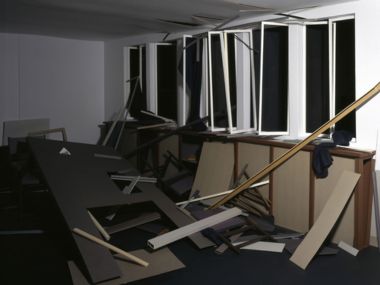
Raum, 1994
In Raum / Room (1994), we are confronted with a chaotic scene of destruction: a room that has been blown apart. A table has collapsed onto the floor, with a crumpled sheet of paper lying on top of it. There are broken chairs strewn everywhere. The windows have been torn from their frames by the explosion. The ceiling panels have come loose. What happened here? What period is this set in? Are these the unsettling and disturbing aftermath of some kind of natural disaster or a deliberate act of destruction? Or is this simply a scene of architectural decay and neglect?
The image itself offers few clues, leaving it open to endless narrative speculation. The image originates from a photograph of a dramatic episode in history: the failed attempt by Claus von Stauffenberg and his conspirators to assassinate Hitler in July 1944.
Demand has suggested that he was drawn to reconstructing this image because of its frequent appearance in the school textbooks of his childhood, a fact which, in itself, demonstrates the intertwining of history and memory in the world of images.
In a sense, we might regard Raum / Room as Demand’s first image of disaster. Despite the precision and meticulousness of its reconstruction on paper, there remains an unsettling sense of the catastrophe that this event failed to avert and, at the same time, an uncertainty about exactly what happened.
Archiv, 1995
The monumental work Archiv / Archivo (1995) features neatly arranged stacks of cardboard boxes, with the presence of a staircase bringing the scene to life. It is one of the first works in which Demand addresses moments of German history; in this case, the archive of filmmaker Leni Riefenstahl.
What is depicted here? What aesthetic or historical ghosts do these boxes contain? We find no reference that would allow us to identify their contents, unlike what usually happens in an archive, where the items being preserved are labelled.
Significantly, this is neither a tribute nor a reconstruction of Riefenstahl’s images, but rather a physical recreation of the raw materiality of her archive. Archiv / Archive is an image that portrays the weight—both physical and cultural—of an artist’s archive, whilst denying the viewer access to the images it contains.
Its rigorous, almost minimalist seriality offers a different perspective on the act of preserving information that constructs memory and history. Archiv / Archive is also a silent image of another kind of disaster, embodied in the career of an undeniably brilliant filmmaker who chose to create her work in the service of an immoral regime.
Badezimmer, 1997
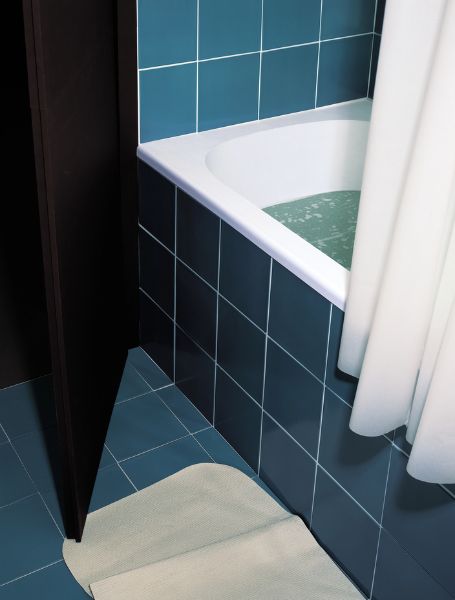
In Bathroom (1997), Demand recreates an infamous news photograph of a bathtub in the Hotel Beau-Rivage in Geneva, Switzerland, where Uwe Barschel, the Minister of the German state Schleswig Holstein, was found dead on October 11, 1987, of an apparent suicide that has been variously theorized as a murder.
Barschel was the center of a political scandal in which he was accused of hiring a private detective to uncover damaging information about the sex life of one of his party’s political opponents. Having been forced to resign his position, Barschel flew to Geneva and checked into the Beau Rivage Hotel where he was hoping to meet an informant with information that would clear him of any wrongdoing in the scandal
The image of Barschel’s lifeless body taken by the journalist who discovered his body one day later became the center of a story about the ethics of photojournalism as well as the use of photographs in constructing political narratives. Demand empties the image of the politician’s body and leaves the viewer with only the scenographic remnants of the political theater of images.
Büro, 1995
A few months after the fall of the Berlin Wall (1989), thousands of citizens stormed the offices of the Stasi, East Germany’s secret police, destroying and ransacking its archives. For years, these had been used as a tool for surveillance, repression and political persecution. The incident was widely reported in the press at the time.
Demand recreates one of those images in a 1:1 scale cardboard model, which he then photographs. This is how he created Büro / Office (1995): a ransacked office, with the material that had been accumulated and guarded for years scattered throughout the room. A solitary articulated lamp bears witness to the scene, whilst the sheets of paper remain blank, refusing to offer any clues as to their purpose or the information they might have contained. These sheets take the place of files that recorded secret observations on the lives of individuals living under the surveillance of a police state.
In both Archiv / Archive and Büro / Office, the archive is the subject of the work. Although they belong to two different historical periods, both pieces bear witness to the circulation of images and the politics of memory.
Gallery 2
Pacific Sun, 2012
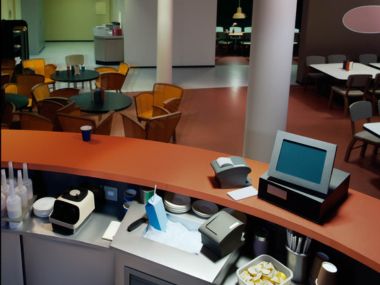
A particular slap stick absurdity underlies Demand’s epic stop-motion animation Pacific Sun (2012). In this film the artist reconstructed two minutes of security footage from the cruise ship Pacific Sun as it was hit by gigantic waves during a tropical storm off the coast of New Zealand. Removing the employees and guests, Demand spent months painstakingly conjuring with paper and cardboard the shambolic flow of chairs, tables, storage cabinets, paper plates, computer monitors, and, rather hilariously, a single potted plant as they careened back and forth below deck.
The ultimate absurdity here is Demand’s excruciatingly fastidious act of re-creating a few moments of uncontrolled chaos as the natural world unexpectedly buffeted the manufactured engineering of the boat. In his directorial reconstruction of this almost Brechtian disruption of the happy middle-class dream of a cruise ship holiday, the artist becomes a choreographer of the world around us, using paper to reconstruct a random ballet out of the flotsam and jetsam of the inert and starkly unremarkable objects that silently populate our lives.
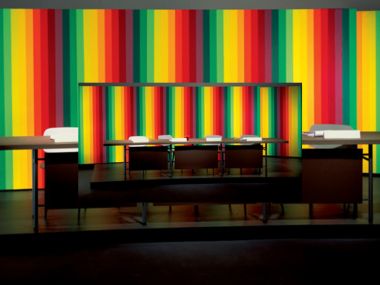
Studio, 1997
In Studio (1997), Demand foregrounds his ongoing concern with the construction of visual truth as he recreates an archival photograph of the television set of the 1970s West German television quiz show “Wer bin ich?” (Who am I?).
The first example of this now common televisual genre on German television, “Who am I?” involved a panel of semi-famous figures attempting to guess the profession of a mystery guest through a series of questions.
Invoking the perpetual dance between truth and fabrication, Demand’s depiction of the empty—yet colorful—set designs for this program highlights the dissemination of images through this broadcast medium and its role in the creation of lived fictions.
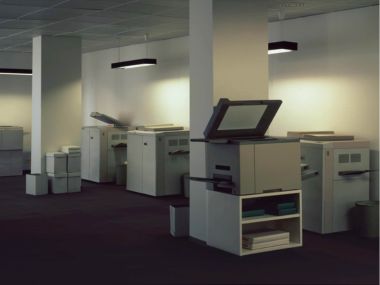
Copyshop, 1999
In a number of Demand’s works, both the strategic and the philosophical implications of repetition and the duplication aspects inherent in mechanical reproduction become his central theme , within a highly self-aware exploration of his own studio practice. In Copyshop (1999), for example, we see a wide-angle perspective on the most generic scene of late twentieth-century mass reproduction: a neighborhood copy center. Under the numbingly institutional glow of hanging fluorescent light fixtures, in a room so nondescript that its blank acoustic ceiling tiles are almost decorative, a convocation of seven photocopy machines sit in varying states of attention. There is something about the deadpan nature of this image and its meta-commentary on Demand’s practice of re-creating images of the world in (as opposed to on) paper that makes it almost comedic. One can imagine Jacques Tati’s film character Monsieur Hulot bumbling around this room attempting to make copies of an official document but forever being frustrated by paper jams and “replace toner” warnings.
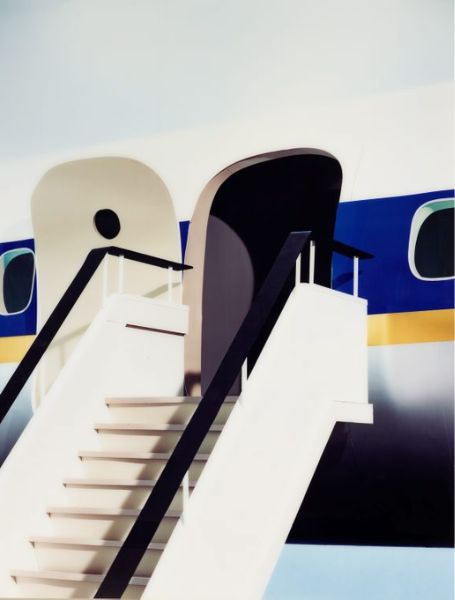
Gangway, 2001
In Gangway (2001), the open yet empty doorway of a generic passenger jet is rendered both unspectacular and uncanny. Has someone just deplaned or are we waiting in anticipation for a famous figure to appear in a grand entrance?
While the source for this work was a news photograph of Pope John Paul II visiting Berlin, Demand’s image is devoid of any human figures—either world historical or anonymous. The artist draws our attention to the airplane’s gangway as a site of photographic theater where scripted “entrances” take place in a dramaturgical politics of the circulation of images.
Whether it’s the Beatles landing in the United States or the Pope’s arriving in Berlin, we are left wondering as much about how these photographic moments are constructed as we are about the identities of the actors.
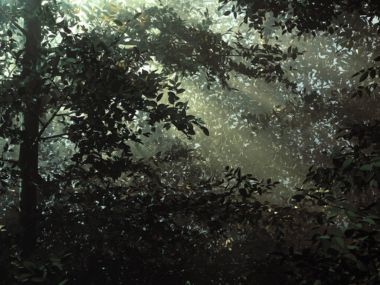
Clearing, 2003
For his work Clearing (2003), the artist constructed over 270,000 paper leaves to create an idyllic scene of a forest with a golden light pouring through its canopy.
Clearing speaks to the unfounded Romantic vision of a pure, unadulterated prelapsarian nature that has never ever existed outside of the philosophical frameworks of humankind. Demand’s paper reconstructions of these scenes are no less artificial than these utopian “no places.” In the end, Demand’s image asks: in a world so fully suffused with artifice, “what is the natural?”
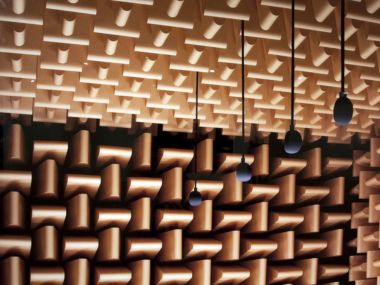
Labor, 2000
In Labor (2000) Demand recreated an image of an anechoic chamber, a soundproof echoless room, specifically engineered by the automobile manufacturer BMW to test the noise levels of cars as if they were speeding through an empty field devoid of wind or any acoustic obstacles.
Demand’s image depicts a fragment of this chamber—the uppermost part of the chamber where a corner meets the ceiling. Almost abstract in its appearance with its highly engineered acoustic foam pylons forming a kind of geometric Moiré-like texture, we are brought back into the here and now as the four microphones suspended from the ceiling come into focus.
Used to capture the sounds generated by BMW’s tests, these microphones signal a purpose parallel to that of Demand’s camera in that they record the acoustic simulations of the real world as recreated in this laboratory. In this work Demand has captured the visual look of the sound of silence while revealing the artifice at work in the world of engineering.
Gallery 3
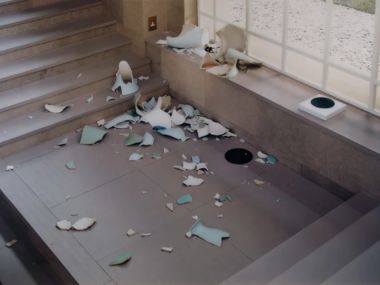
Landing, 2006
In Landing (2006) we see the aftermath of a highly unfortunate accident that occurred at the Fitzwilliam Museum in Cambridge in 2006. As the story goes, a museum visitor realized he was going the wrong way, turned, tripped on his shoelace, and took a fall that ended in the destruction of three Qing Dynasty vases displayed on a staircase landing. The irony of Demand’s meticulous and exacting paper reconstruction of this scene of destruction is not lost on us, as his model would itself end up in the recycling bin after being photographed. The conservation and preservation of material culture—an essential role of museums—is here explosively undone by an unfortunate choice of location, poor wayfinding signage, and a pratfall worthy of slapstick master Buster Keaton.
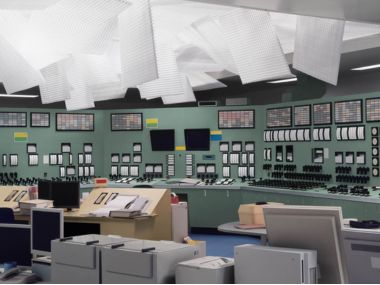
Control Room / Sala de control, 2011
In Demand’s work Control Room (2011), the artist has constructed some kind of generic industrial-scientific complex arrayed with consoles replete with unrecognizable gauges, multiple control levers, computer screens, and read outs. Surprisingly, the desks are also populated by file folders full of papers and what appear to be operating manuals. As with all of Demand’s work, this space is devoid of any visible human presence, its blank screens implying that this is a dead space.
After an initial scan of this image, it is clear that something is not quite right here. We notice that the plastic tiles of its illuminated dropped ceiling have all come loose and hang precariously over this abandoned control room. Only after learning that this is a re-creation of a Tokyo Electric Power Company technician’s cell phone image of the abandoned and severely damaged Fukushima Daiichi nuclear power plant in the aftermath of Japan’s 2011 Tōhoku earthquake and tsunami do we begin to question the mute serenity of this image, which in the end is about technological hubris and the illusion of control. When talking about the original images from Fukushima, Demand has stated that “we are not looking at disaster but at an image of disaster.”
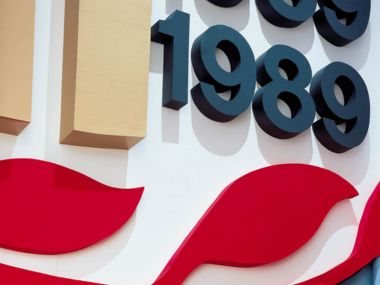
Podium, 2000
Podium (2000) documents the site where Slobodan Milošević, a Serbian politician and one of the most influential and controversial figures in the contemporary history of the Balkans, delivered an inflammatory political speech. The event commemorated the 600th anniversary of the Battle of Kosovo as celebrated by Serbian nationalists—an occasion that foreshadowed the horrors of subsequent wars and ethnic cleansing in the Balkan region.
The small podium, with its signs of human presence—microphones and a water glass—shrinks in significance underneath the quasi-fascistic graphic design of its stage. Significantly, this is one of the few works by Demand that offers any graphic clues as to its origins and significance.
His reproduction of the numerical rendition of the years “1339” and “1989” in the stage backdrop had an overdetermined ideological connotation within that context that would produce the oncoming human tragedy.
Tribute, 2011
C-Print / Diasec
166 x 125 cm
Prueba de artista
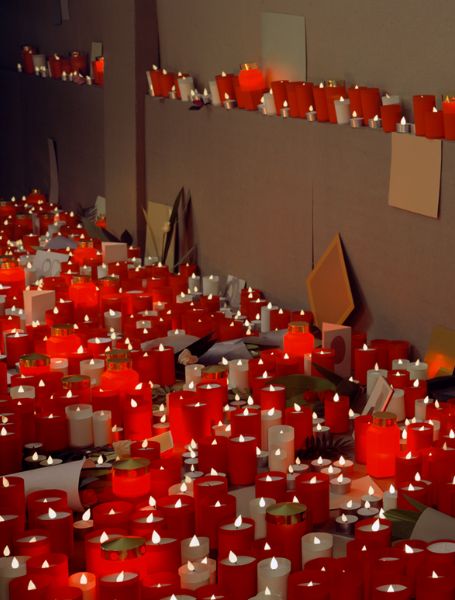
In Demand’s Tribute (2011), the artist recreates a photograph of a spontaneous shrine that arose in the wake of a tragic episode of mass panic at a rave. Memorials such as this are makeshift, transitory monuments constructed hastily through the uncoordinated actions of anonymous individuals and then preserved and circulated in photographs before their eventual disappearance.
In this work, which depicts a bricolaged altar destined for the waste bin, Demand addresses the fragility of memory and its reliance on a photographic record to give it sustenance. In the wake of the torrential flood of tragic events in the media with one displacing another with a voracious rapidity, images such as these act as reminders that keep particular tragedies in the public consciousness for one or two extra days while news reporting catches up before they eventually fade into the forgetful abyss of the news cycle.
Ruine, 2017
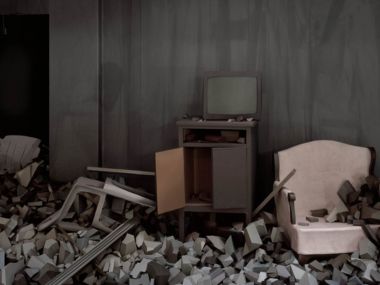
Sometimes, a disaster is far from spectacular in its visible effects. Demand’s Ruine / Ruin (2017), on the other hand, becomes a kind of stock image of all the disasters that circulate in the news media around the world. This nearly colorless depiction of a destroyed room, with its universally recognizable plastic chairs buried in rubble, is a flat and banal counterpoint to the Grand Guignol of Andy Warhol’s silkscreen car crashes. We don’t need to know that the original source image captured children playing in this wreckage of a home in Gaza after a missile strike, as images like this have become depressingly interchangeable and circulate digitally as generic markers of an almost pornographic deployment of disaster and suffering. Demand’s intentionally blank paper repetition of one of the endlessly interchangeable tragedies of contemporary conflict makes us question the very circulation of these images in the political economy of suffering, resistance, and exploitation that has come in part to define our contemporary culture of image consumption.

Folders, 2017
In Folders (2017), Demand asks us once again to consider the role of paper in the grander scheme of history. This image is a reconstruction of the theatrical presentation of “evidence” by Donald Trump and his lawyers at a press conference in January 2017, in which he pledged to remove himself from control of his various business interests before assuming the United States presidency in order to remove any conflict of interest. The press conference was marked by the then-President’s extreme unwillingness to allow reporters to look more closely at the stacks of folders which themselves suspiciously looked to be full of empty sheets of paper. Here paper becomes a veritable sculpting of “truth” deployed in the service of politics.
Balloons, 2018
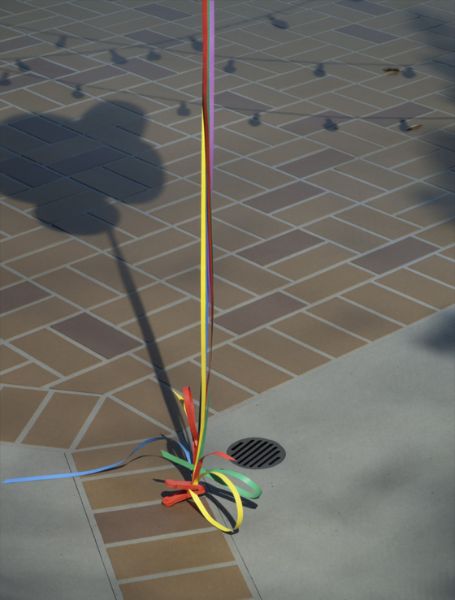
A bouquet of balloons floats lazily across a concrete and brick sidewalk, its gaseous buoyancy held in tentative abeyance by the weight of a bright red plastic clothes pin. Unable to fully escape the effects of gravity, yet not quite securely moored to the ground, we see the ribbons tethering the balloons move to and fro as they engage in a drunken, haphazard minuet. The balloons themselves exist in a state of visual limbo hidden just outside of the edges of the screen, their looming presence marked only by the shadows that they cast on the ground. This scene of casual grace was painstakingly reconstructed out of paper and brought to life one shot at a time by Thomas Demand’s stop motion animation technique. Thousands of subtle movements were individually recorded in this cinematic symphony of a city made of paper. In Balloons (2018), Demand brings to life the poetry of the overlooked moments of everyday life that fill the voids between the supposedly more meaningful appointments that fill our calendars and date books while its shadowy suggestion of a group of hovering balloons evokes a Chaplinesque rendition of Plato’s parable of the cave in which shadows are seen as an imperfect approximation of the ultimate truth of the world.
Model Studies
Sphere 93, Sphere 17 / Esfera 93, Esfera 17, 2015 Kindergarten 22 / Guardería 22, 2015 Learning Center 50 / Centro de aprendizaje 50, 2015 Printing Factory 56 / Fábrica de impresión 56, 2015 Farm 31 / Granja 31, 2015 Chiffchaff / Mosquitero (ave), 2020 Chaffinch / Pinzón (ave), 2020 Grosbeak / Picogrueso (ave), 2020 Kinglet / Reyezuelo (ave), 2020 Sparrow / Gorrión, 2020 Starling / Estornino (ave), 2020 Impresiones de pigmentos enmarcadas
165,3 x 129,4 cm
Temple 54 / Templo 54, 2015
122,5 x 156,1 cm
122,5 x 156,1 cm
122,5 x 156,1 cm
165,3 x 129,4 cm
122,5 x 156,1 cm
135 x 172 cm
172 x 135 cm
135 x 172 cm
135 x 172 cm
172 x 135 cm
135 x 172 cm
Pruebas de artista
As Thomas Demand has suggested when discussing his practice, “I guess the core of it is making the world into a model by redoing it and stripping off the anecdotal part, that’s when it becomes an allegory, and the project becomes a metaphor. Making models is a cultural technique—without it we would be blind.”
Perhaps this is why he moved away from his technique of sculpturally reconstructing existing images of the world to focus his lens directly on the existing preparatory paper models of architects and designers in his Model Studies series while he was in residence in 2011 at the Getty Research Institute in Los Angeles.
Whether by offering us fragmented and unadulterated views of the flimsy and surprisingly provisional maquettes of midcentury architects like John Lautner and contemporary architectural firms like SANAA, or of the radical paper dress patterns of the fashion designer Azzedine Alaïa, Demand’s Model Studies reveal that the world around us is constructed on a foundation of paper.
Hanami, 2014
"At the foot of the stairs leading into the garden there was a cherry tree covered with what appeared to be magnificent blossoms. I was surprised that it should have bloomed so early, and it occurred to me that, if the cherry was already out, the plum trees must be at their height. Then I realized that the flowers were artificial. Their tint, however, was in no way inferior to that of real blossoms. What skill must have been needed to make them look so life-like! It saddened me to think that they would all be ruined if it started to rain.“
This observation by Sei Shonagon in her early 11th century reflections Pillow Book inspired Thomas Demand’s Hanami (2014), one of the artist’s wallpapers–photographic works created specifically to be produced and hung as immersive architectural experiences. In this work the artist recreated myriad Japanese cherry blossoms out of paper which he then photographed to produce this densely encompassing image. It’s title Hanami refers to the traditional Japanese custom of acknowledging the transient character of both beauty and life by celebrating cherry tree blossoms during their short Spring-time bloom. In the case of Shonagon’s observations on artificial cherry blossoms and Demand’s deliberate recreation of his flowers out of paper, Hanami offers us a meditation on both the fleeting and cyclical character of life as well as the power of simulation to create beauty in the face of the brutal reality of the world.
Zimmer, 1996
In Zimmer (1996), Demand reconstructs an image of the hotel room where the controversial American writer and Scientology founder L. Ron Hubbard lived and worked between 1972 and 1973. Hubbard was famously reclusive, lived his life and worked in hotel rooms and was rarely photographed (there are only seven known existing photographs of the author). Devoid of the actual presence of the prophet of a so-called church, we are presented only with the tools of the dissemination of his ideas—an electric typewriter, paper, books, an ashtray and a coffee cup—all of which are casually tossed about in a well-used and disheveled room. Demand’s photograph presents us with a Wizard of Oz moment by pulling back the curtain and revealing the true origins of an author who went on to construct a cult-like global organization with its own questionable claims to the truth.
Gallery 4
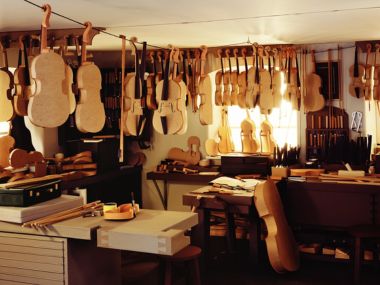
Werkstatt, 2017
In Werkstatt / Workshop (2017) Demand presents the viewer with another perspective on the artist’s atelier in the form of the orderly interior of a luthier’s studio. Based on historical photos from a Bavarian village celebrated since the seventeenth century for its exceptional violins, the image includes racks of tools and dozens of instruments in various stages of completion. Describing the violin as having “a shape that has fallen out of time,” the artist emphasizes the continuation of the very traditional and sophisticated handmade craftsmanship of violin makers. As such, Werkstatt / Workshop becomes a metaphor that acknowledges the perseverance of the hand in the face of the robotic industrialization of our contemporary world.
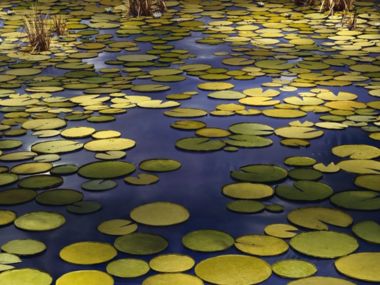
Pond, 2020
While Demand has turned his attention to the effects of the natural world—and specifically the ocean—in works such as Control Room and his film Pacific Sun– he has also been interested in our culture’s production of “nature” since the beginning of his career. In Pond (2020) he rendered a scene completely filled with water lilies. Monumental in scale, Demand’s pond fills the viewer’s field of vision horizontally to create an almost immersive environment while partaking in the hackneyed discourse of beauty generated by the dissemination and wall-poster popularization of Monet’s Water Lilies.
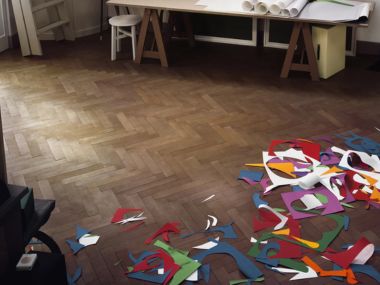
Atelier, 2014
In Atelier (2014), Demand has recreated a photograph of Henri Matisse’s studio that the artist carried around for many years. Here we see a warm profusion of the multicolored remnants of Matisse’s paper cutouts, strewn across the golden parquet floor of his studio with a kind of nonchalant sprezzatura as he worked. In Demand’s paper recreation of this photograph, Matisse’s cuttings become markers of the negative space of the artist’s creative process and an acknowledgment of both the delicate ephemerality and the endless possibilities offered by the medium of paper. Atelier’s warm explosion of color and personal creativity provides a philosophical bookend to the dark pathos of the use of paper in the explosion of secret police dossiers in Office or the nihilistic staging of political “truth” in the form of Donald Trump’s stack of so-called documents in Folders.
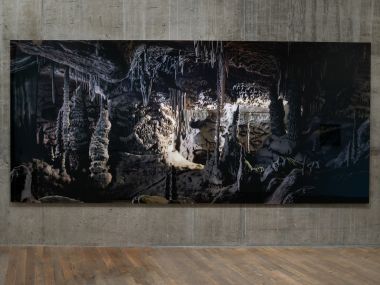
Grotto, 2006
Throughout his career, Demand has been interested in our culture’s production of “nature.” In the end, many of Demand’s images ask, in a world so fully suffused with artifice, “what is the natural?” In Grotto (2006), for example, Demand famously attempted to ask this question by calling our attention to the legacy of the aesthetic theory of the Sublime in nature in relation to the power of photography to form (or deform) experience and personal memory.
To produce this image, Demand used thirty-six tons of cardboard to construct a life-size underground cavern before preserving its image photographically. Like the stalagmites and stalactites it depicts, which have been built up geologically over millennia out of the mineral content of dripping water, Demand constructed this work out of layer after layer of cardboard. The image it recreates is one that we might have seen many times before in the thousands of postcard images of caves sold in gift shops around the world. The artist gathered hundreds of these postcards, and the final photographic version of Grotto becomes an ideal condensation of our collective image of a cave that has itself been mediated by the long history of photography.
In this work, the terrifying grandeur of the eighteenth-century philosophical Sublime becomes the Instagram generation’s idea of a “photo opportunity”, and the spectacle of nature is reduced to a daily post. As if to accentuate the point that neither the Sublime nor the Instagram photo are any less constructed than one another, Demand allowed the model for this work to be preserved (just this one time, unlike all of his previous or subsequent models), and it currently sits on view in Milan in a basement gallery at the Prada Foundation along with vitrines full of his research. Perhaps the sheer weight of its factual material existence and its case-study approach to the concatenations of memory and photography led Demand to allow for Grotto’s continued physical existence alongside its photographic counterpart: a kind of memorial to the mutual imbrication of objects, memory, and the process of photography.

Klee, 2025
Copper is an original element on the periodic table (no. 29, Cu). When it comes to the history of art, Demand thinks of this metal as “a rather auratic material.” In the sixteenth century, artists turned to painting on copper because wood would warp and canvases on stretchers weren’t widely used yet. Copperplate engraving was also one of the first techniques used to mechanically reproduce images in the early 15th century while centuries later the first photographs were also printed on copper. Demand turned to copper as a support for this work as analogue photography printing techniques such as dye transfer and chromogenic processes have abruptly disappeared. Klee / Clover is the first image printed by Demand on copper. The picture itself is straightforward and nonnarrative. It delivers only one message: luck
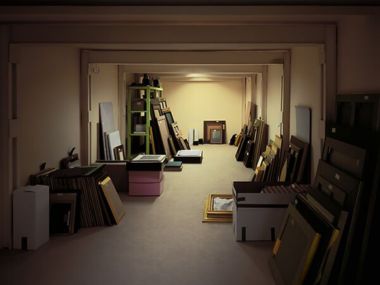
Vault, 2012
The theme of “stolen images” has been an interest of Demand’s for some time, in both its literal manifestations as well as its metaphorical relationship to the practice of photography, and it was the subject of an exhibition that the artist curated in 2016 entitled “L’image Volée”.
Demand’s Vault is based on a police photograph of a storeroom at the Wildenstein Institute in Paris, where thirty paintings and sculptures that had been missing for decades were discovered during a 2011 police raid to investigate alleged tax evasion by the prominent art-dealing family. The photograph accompanied an article published in The New York Times on July 20, 2011.
When confronted by Suzanne Reinach, the heiress of a French Jewish family displaced during the Holocaust, Guy Wildenstein was quoted as stating in a passive claim of innocence that “we have never had an inventory of the vault” and “the heirs had not asked for the return of the artworks, otherwise I would have returned them.”
In Demand’s picture, as in the photograph on which it is based, Mrs. Reinach’s missing—or rather, stolen—paintings, which include works by Degas, Manet, and Morisot, are wrapped and turned to face the walls as mute hostages. Demand has described this vault as conveying the dignity and monumentality of a pharaonic grave.
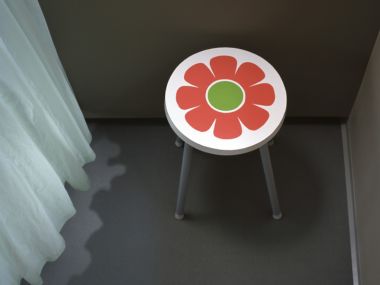
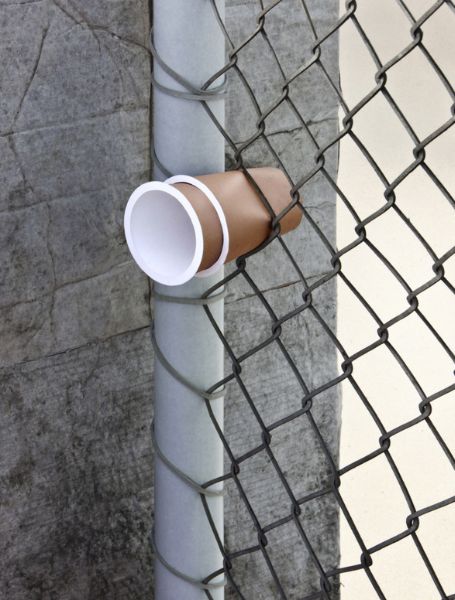
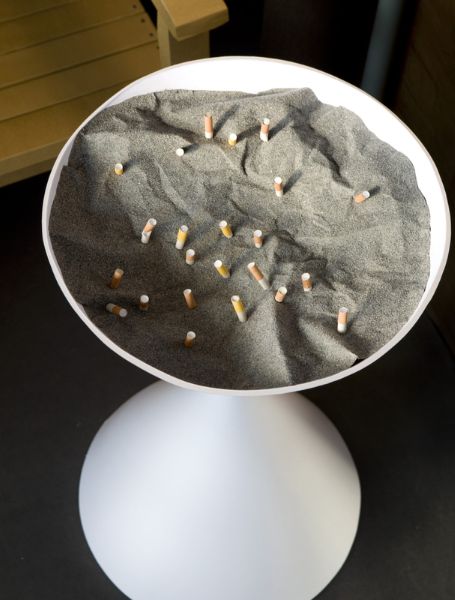
In 2008 Demand made a radical move in his practice that, in retrospect, seems like an almost inevitable closing of a circle, in a shift from the monumental to the personal and quotidian. For his series Dailies, the artist started to construct paper models recreating personal photographs taken with his iPhone on walks through his neighborhood and in the places he traveled. Domestically sized and printed with a soon to be defunct dye transfer process, they are framed in a manner similar to traditional photographs. They depict seemingly ordinary and at times humorously absurd moments that we all pass by unawares each and every day—chewing gum stuck in the grill of an air return, plastic cups inserted into the holes of a chain link fence, an empty frozen yogurt cup with its pink plastic spoon, laundry sitting inert in the window of a clothes dryer, or a taut dog leash wrapped around a light post, its captive located somewhere off screen.
Standing in creative opposition to the grand scale and topics of his larger historical works, they emphasize an intimacy and attention to the minor episodes and often overlooked moments of ad hoc grace, wonder, and hilarity that populate our lives. Every Daily seems to offer the opening sequence to a story that remains to be written. Who left that bar of soap perched precariously on the edge of the sink in Daily #21? How long has that pile of mail been accumulating beneath the mail slot in the front door in Daily #37, and what does it portend? What was written on the yellow photocopied poster with the takeaway tags that is stapled to the telephone pole in Daily #34? “We pay cash for homes”? A phone number to report a missing pet? Perhaps the invisible dog from Daily #28 went missing?
These works are both an autobiographical account of the artist’s movements through the world and a celebration of the narrative power of minor events and situations. Although this series has a quickly approaching expiration date, as the materials and process needed to print these works are quickly disappearing, the Dailies will nonetheless continue to offer a complementary personal counterpoint to Demand’s more monumental photographic reconstructions of the marginal images of history. When history stutters, Demand’s Dailies fill the gaps.