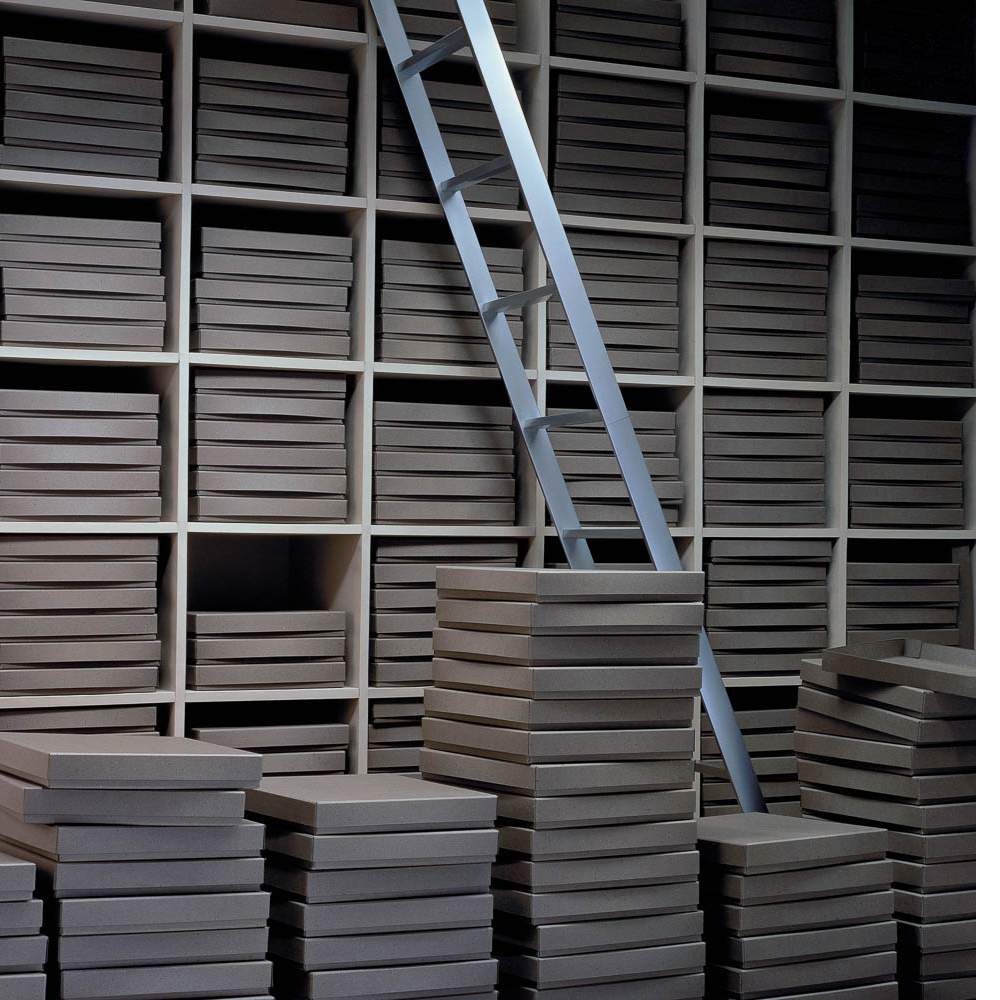
 Thomas Demand. Archiv / Archivo, 1995
Thomas Demand: The Stutter of History Memory and Atrophy Without a Trace Photographic Memory An Idea and a Little Paper Thomas Demand: “The Screen Always Lies” My Pictures Give You a Picture of Your Future Memory
by Douglas Fogle
by Margaret Iversen
by Michael Fried
by María Gainza
by Russell Ferguson and Thomas Demand
by March Mazzei
by Ruby Boddington and Thomas Demand
Photographic Memory
by María Gainza
Excerpts from the text originally published in Página/12 (October 2, 2005)
If -as the Indians used to say- photographs steal people's souls, what does photography do to places? In a perverse game, almost as if he wanted to reconstruct life from the dead, the German artist Thomas Demand reconstructs, in life-size cardboard models, places that were photographed long ago in newspapers or magazines (rooms, offices, brothels, crime scenes), and photographs them again. Only to reveal the terrifying reverse side of memory: a place stripped of all particularity, as cold as the distance between a word and the feeling it attempts to convey.
[...]
Since the early 1990s, Thomas Demand has followed the same procedure: first, he chooses a photographic image published in a newspaper or magazine; then he builds a life-size model of that image out of paper and cardboard, lights it with that cold elevator light that absorbs all traces of humanity, and photographs it. He then destroys the model. Only a reverberation of the original photograph remains. If there used to be an office desk cluttered with things, now we have that same desk stripped bare. It is not that the objects have disappeared, but that they remain there, stripped naked: what was once superfluous detail has been eliminated, leaving something like an outline of the original, but without its particularities. We see only the net content of the image: the papers are blank white rectangles; the cigarette pack is an unbranded box; the typewriter has its familiar shape, but all the keys are black; the adhesive tape is a roll without a logo. Everything is rendered in colors reminiscent of old technology laboratories—a greenish beige, somewhere between milky tea and a Cubist painting.
The images could be the result of a mind that is unable to remember details, retaining only the broad outline of things it once saw. In this regard, Jeffrey Eugenides (who himself wrote a story inspired by Demand's photographs for the catalogue of the exhibition at MoMA that year) wrote: “A memory of a time or a place is not that time or that place, and, even as the mind struggles to perceive the present, there is the inevitable filter of consciousness: our mind constructing a portrait of reality.” It is possible that, in part, Demand's images are works about memory and perception. About what we remember of things and why. Nothing better than paper, here in its dual function as sculpture and photography, to represent the fragility of things.
[...]
Born in Munich in 1964, Demand studied theater and church design before entering the legendary Düsseldorf Academy, where Bernd and Hilla Becher were training Thomas Struth, Andreas Gursky, Thomas Ruff—the so-called “Struffsky School” that would send photography prices soaring. Like his peers, Demand produced large-scale photographs with the formal impact of hard-edge abstraction and the allegorical density of Neo-Expressionism. But ten years younger than them, he never felt part of the clan, which gave him a certain mental freedom. When he entered the Academy, his main interest was sculpture: he used photography to document his works; only later would he use his works to make photographs.
[...] if there is something missing from his photographs, it is something like a sign of life. There are traces of people—a coffee cup, a cigarette pack—but not much more. Or worse: the problem is not the solitude of the scene (that would, in any case, be the least of it), but the oppressive anonymity. There are no traces of fingerprints, no singularities, no effects of time on things, none of that opacity given to objects by the dirt of touch, wear and tear, that greasy residue hands leave on surfaces. Indeed, what we find is a sheen that, by being so cold, becomes disgusting. It evokes something between the slight aestheticization of Dieter Rams's postwar designs and the ultra-hygienic atmosphere of a dentist's office.
[...]
Without any prior explanation, one could not recognize the places; at most, they might resonate as the residue of a news story, something that was a headline one day and did not even make a footnote the next. For example, there is The Bathroom, a reconstruction of a famous photograph in Germany. The story goes like this: an amateur photographer found a guest dead in the bathtub of a hotel. Instead of rushing to the telephone to alert the police, he climbed onto a stool and took a photograph. It showed a man in a white shirt and black tie submerged in water. The image was published to exhaustion, and the photographer was accused by the media—the same media that had eagerly published the photograph—of voyeurism, trespassing, and amorality. A few years later, that same photograph was used as evidence for a conspiracy theory: the shoes and socks shown in the photograph displayed signs of a deadly poison that forensic investigators had overlooked.
Demand's reconstruction shows a view of that same bathroom; beside it is a photograph of a small table with a little heater, a chair, and an empty ashtray. We know that it is the reconstruction of an image taken inside a brothel in Times Square, New York. The original photograph was taken during a raid in the 1970s, in an attempt by the government to shut down the neighborhood's red-light district. These two images, anchored in public events, are followed by one of a chrome sink with a coffee cup, a glass, a plate, and a spoon, and another of a worktable covered with papers. There is not the slightest indication of whom any of this belongs to or why it is there. Yet, intermingled, the images contaminate one another; in all of them, one begins to sense a certain threatening banality of evil.