Talks and Reflections | Thomas Demand: The Stutter of History
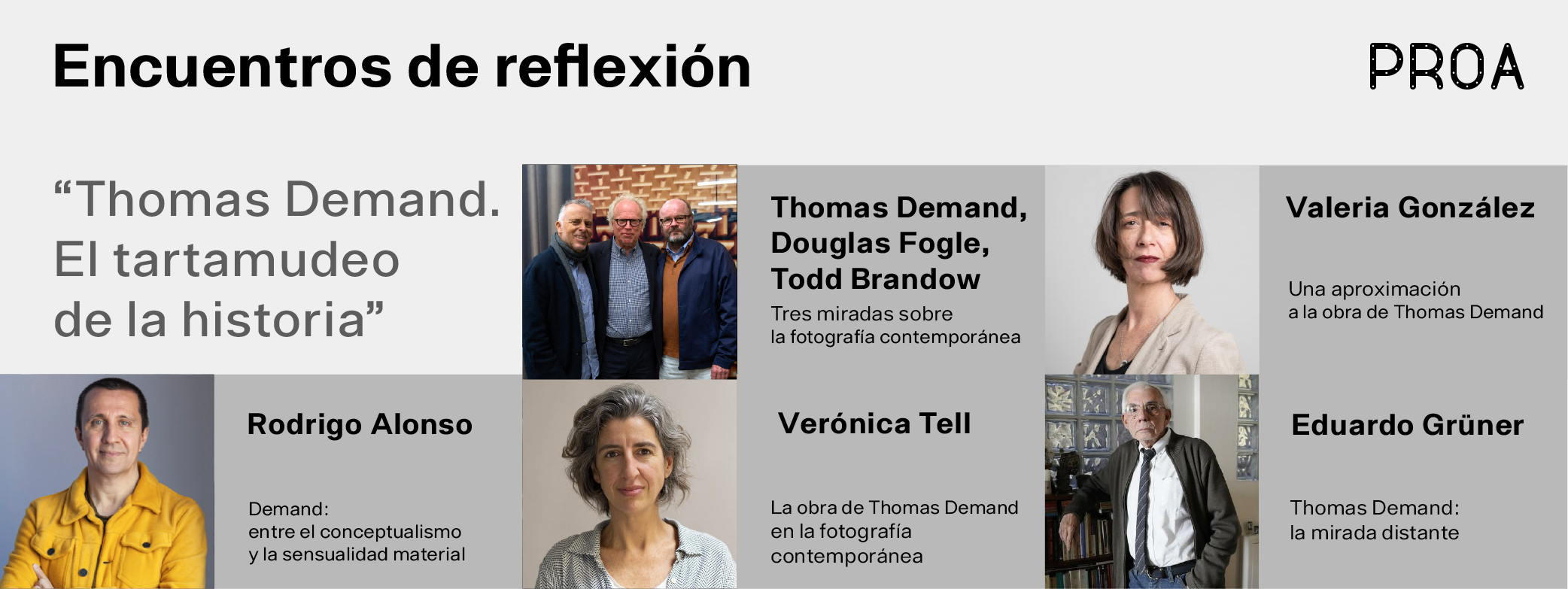
- Three Perspectives on Contemporary Photography: Thomas Demand, Douglas Fogle, and Todd Brandow
- An Introduction to the Work of Thomas Demand, with Valeria González
- Demand: Between Conceptualism and Material Sensuality, with Rodrigo Alonso
- Thomas Demand’s Work in Contemporary Photography, with Verónica Tell
- Thomas Demand: The Distant Gaze, with Eduardo Grüner
Three Perspectives on Contemporary Photography: Thomas Demand, Douglas Fogle, and Todd Brandow
- Friday, August 21, 2026
An artist, a curator, and the founder of FEP come together in Proa’s Auditorium for a special event exploring three central dimensions of contemporary photography: artistic production, curatorial practice, and the organizational work that enables exhibitions to circulate internationally.
What makes a photographic work relevant when it draws on images already circulating in the media? How do you build a retrospective spanning three decades of work? What network of institutions, curators, and producers enables an exhibition to travel between countries and reach new audiences? These questions run through the event bringing together German artist Thomas Demand, curator Douglas Fogle, and Todd Brandow, director of the Foundation for the Exhibition of Photography (FEP), a collaborating institution on Thomas Demand’s exhibition at Proa.
This unique opportunity takes place in conjunction with the German artist’s exhibition, presented by Proa for the first time in Argentina, featuring more than sixty works spanning three decades of a practice situated between photography and sculpture.
The joint presence of Demand, Fogle, and Brandow offers three distinct yet complementary perspectives on this exhibition project.
In a conversation with the curator, Demand shares his working process, the relationships between photography, memory, architecture, media, and history that shape his practice, and the decisions involved in moving from an image to its physical reconstruction and the final photograph. Douglas Fogle discusses the process of building a retrospective: selecting works, establishing connections between different periods, developing thematic frameworks, and translating curatorial research into the exhibition space. Finally, as director of FEP, Todd Brandow offers a third perspective on exhibition management, the international circulation of photography, and the models of collaboration among museums, foundations, curators, artists, archives, and collections that make projects of this scale possible.
An Introduction to the Work of Thomas Demand, with Valeria González
- Wednesday, September 2, 2026
A historian specializing in contemporary art, González explores Thomas Demand’s work and its connections with conceptualism, hyperrealism, the German photographic tradition, and the notion of collective memory, examining a practice that questions photography’s apparent objectivity.
A history graduate specializing in contemporary art, González offers an overview of Demand’s practice through its art-historical precedents, from the 1970s to the present: conceptualism, hyperrealism, and German photography of the second half of the 20th century.
The artist’s work evokes unease and a sense of mystery because its real-world references remain hidden. Although his photographs simulate the real world, closer observation reveals that they capture only a fragile resemblance. What we actually see are ephemeral recreations made of paper and cardboard, constructed by the artist solely to be photographed. His work thus challenges the notion of truthfulness, reminding us that our memory is shaped by photographs circulating in the media that become mental images.
Alongside the tension between source and reference, the session examines the question of time, both in his creative process and in the images he produces; the concept of generic and collective memory that Demand draws upon; and how this reinforces the idea of a German tradition of thinking about photography that, since the 20th century, has urged us to “distrust images.”
—
Valeria González
Holds a degree in Art History from the University of Buenos Aires (UBA), specializing in contemporary art. She has taught at university level since 1998 and currently teaches at UBA and the National University of Tres de Febrero (UNTREF). As an independent curator, she has organized more than 40 exhibitions. In 2016–2017, she directed the Casa Nacional del Bicentenario, where she developed the CNB Contemporánea project. In 2018–2019, she served as Research Secretary at the School of Art and Heritage at the National University of San Martín (UNSAM), where she designed the curriculum for the newly established undergraduate degree in Contemporary Artistic Practices.
Demand: Between Conceptualism and Material Sensuality, with Rodrigo Alonso
- Thursday, September 17, 2026
Alonso approaches Demand’s work from two perspectives: that of an artist interested in ideas and that of an artist obsessed with constructing every detail with precision. Through this interplay of concepts, materials, and images, the session reveals the complexity behind his photographs.
In this session, the curator examines one of the central tensions in Thomas Demand’s work: the relationship between its conceptual dimension and the extraordinary technical rigor required for its execution.
At first glance, Demand’s photographs may appear cold and distant. Yet behind this visual economy lies a painstaking production process. The German artist reconstructs scenes, spaces, and objects in paper and cardboard, drawing on photographs of real events. Once the models are complete, he photographs them.
This procedure offers an opportunity to reconsider his relationship with the conceptual tradition, which, since the 1960s, has questioned the importance of technical skill and formal qualities as essential values of a work of art. In Demand’s practice, this legacy coexists with a meticulous command of materials and techniques of representation.
His work thus brings together two dimensions often seen as opposing: idea and craft, the real-world referent and its reconstruction, documentary appearance and artifice. His photographs reproduce recognizable images with great precision, yet what they show is not the original site of the event but a model built specifically to be photographed.
Drawing on this distinctive methodology, Alonso explores Demand’s practice to examine how art history, conceptual thinking, and the material possibilities of representation intersect within it. The session also considers how his photographs reveal that every image involves an act of construction, and that even what appears to be a document may be the result of an elaborate artistic process.
—
Rodrigo Alonso
Holds a degree in Arts, specializing in contemporary art and new media. A researcher and theorist in technological art and performance, he is a leading authority on the history and current practice of these fields in Latin America. He has published numerous essays and books on the subject. In 2015, he published a collection of his principal writings in Elogio de la low-tech. Historia y estética de las artes tecnológicas en América Latina (In Praise of Low-Tech: History and Aesthetics of Technological Arts in Latin America).
Thomas Demand’s Work in Contemporary Photography, with Verónica Tell
- Thursday, October 1, 2026
In this session, the specialist in images and photographic archives considers Demand’s work through a series of questions: What new approaches to collective memory and political trauma does the artist offer? What relationship between reality and simulation do his images propose? In what ways does his practice challenge the photographic medium?
Images play a central role in how we construct our relationship with the world. They do more than record events: they also select, organize, and produce meaning. Photography, in particular, has historically been associated with the idea of evidence, as though whatever appears before the camera constitutes proof of what happened. Yet what happens when that certainty begins to be questioned?
This session explores the capacity of images to construct narratives about the past, activate memories, and shape what a society remembers. The conversation focuses particularly on the relationship between representation and experience, and the tensions that arise when an image lies at the boundary between the real and the constructed.
Drawing on these questions, contemporary art and photography specialist Verónica Tell examines the role of images in shaping collective memory and representing events marked by violence and political trauma. How is memory constructed through images? What is included in, and excluded from, what we remember? What happens when a representation can be as convincing as a document?
The session also offers a critical examination of the photographic medium: its apparent ability to show reality, its mechanisms of construction, and the ways images can produce effects of truth. In an era marked by the constant circulation of photographs, archives, news, and digital images, questioning what we see also means asking how we look, what we believe, and how we construct our memories from what is visible.
—
Verónica Tell
Holds a PhD in Art Theory and History from the University of Buenos Aires (UBA). She is a CONICET researcher based at the Center for Research in Art and Heritage (UNSAM–CONICET). She directs the Master’s program in Image Studies and Photographic Archives at the School of Art and Heritage, National University of San Martín (EAyP, UNSAM), and teaches in the undergraduate Arts program at UBA’s Faculty of Philosophy and Letters. She is the author of El lado visible. Fotografía y progreso en la Argentina a fines del siglo XIX (2017) and Formas de desmesura (2019), and co-author of De Tierra del Fuego a Misiones. Gaston Bourquin. Fotografías 1913–1950 (2020).
Thomas Demand: The Distant Gaze, with Eduardo Grüner
- Thursday, October 15, 2026
Drawing on an idea by Claude Lévi-Strauss, the renowned sociologist considers distance as a tool for questioning what we see. The talk explores the social and political dimensions of looking and examines how media and culture construct images that shape our perception of reality.
The title of the talk draws on an idea by anthropologist Claude Lévi-Strauss to reflect on how we look. What happens when we step back from what we see? Can we discover something different when we stop treating images as direct representations of reality?
Through these questions, the session considers distance not only as physical separation but also as a tool for seeing differently. Between our gaze and what lies before us, there is a space of uncertainty that allows us to ask what we are seeing, how we interpret an image, and why we tend to trust it.
Grüner approaches these questions through some of the tensions present in Thomas Demand’s work: the visible and the invisible, presence and absence, proximity and distance, the real and the constructed. These contrasts open up a broader reflection on a contemporary question: how the images circulating around us are produced and how they shape our perception of reality.
The talk focuses particularly on the social and political dimensions of looking. In a culture shaped by images constantly produced and disseminated by the media, digital platforms, and other cultural industries, Grüner proposes stepping back from what appears self-evident and asking who constructs what we see, how they do so, and what remains beyond our gaze.
—
Eduardo Grüner
Holds a PhD in Social Sciences from the University of Buenos Aires (UBA). He is Professor Emeritus at UBA’s Faculty of Philosophy and Letters and holds an honorary doctorate from the National University of Córdoba (UNC). He formerly taught Sociology and Anthropology of Art, as well as Literature and Film, in the Department of Arts at UBA’s Faculty of Philosophy and Letters. He has also taught in various postgraduate programs at universities in Argentina and abroad. He has published around fifteen books in Argentina and internationally. He is a recipient of the National Essay Prize and the Platinum Konex Award.