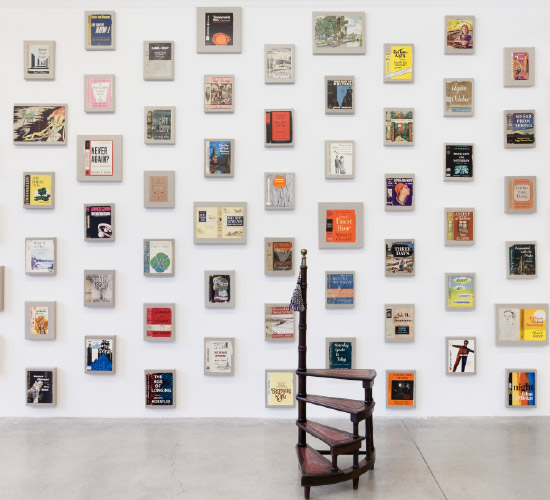
Valeska Soares. Any Moment Now.... (Spring), 2014
Instalación de 93 tapas de libros vintage montadas sobre lienzo y escalera de biblioteca
209 x 609
Col. Balanz
"The Impossible Order of the World"
This exhibition begins from a paradox that runs through our time: the intuition that every attempt to order the world is always partial, fragile, or momentary. The images, objects, and experiences of the present seem to resist any stable structure, as if they moved within a territory where multiplicity and incompleteness were the norm. That mismatch—rather than a problem—becomes an opportunity to look at the contemporary through its own instability.
The exhibition is not organized around fixed categories, but around affinities that open and dissolve, functioning as chapters that invite the viewer to reconsider time, memory, the everyday, and the meaning of materials. Instead of a linear path, visitors encounter a permeable sequence, shaped by ideas and sensations that emerge as the works form unexpected connections. Each gallery offers a different way of approaching time: traces of the past that are rewritten, minimal gestures that reveal layers of urban and domestic life, scenes that oscillate between fragility and permanence. The solemnity of the archive coexists with playfulness; private memories intersect with images inherited from cultural heritage; the intimate blends with the collective.
The exhibition also brings into dialogue two complementary forces: on one hand, monumentality as a presence that organizes space and expands perception; on the other, material urgency, where resourcefulness and the precision of gesture reveal that the strength of a work does not depend on its scale.
That these works can unfold in all their complexity is also the result of the boldness of private collections, which take on the risk of supporting a central process for artists: imagining other ways of seeing. This support makes it possible for the works to emerge today through daring and experimentation. In this sense, collecting becomes a bridge that enables artworks to circulate, to activate, and to find new ways of resonating with audiences.
“The Impossible Order of the World” is an exhibition where the works do not illustrate a concept nor respond to a single reading; instead, they open pathways of connection that each visitor can construct in their own way. In that movement appears a way of thinking about the present, not as a closed system, but as a territory in continuous questioning.
Interview with Adriana Rosenberg
by the Proa Press Department
Starting with the title of the exhibition, what does “The Impossible Order of the World” refer to?
The title emerged from a conversation with curator Francisco Lemus in which we asked ourselves about the methodology one uses when proposing to curate an exhibition or build a collection. Because these are works of art—and each of them generates multiple meanings—the idea of gathering material under a single concept or thematic axis becomes an impossible task. Art, being a polyphony of viewpoints, sensibilities, and tensions, underscores the friction between order and diversity.
How is that concept structured throughout the galleries?
One guiding principle is the creation of atmospheres through works we might describe as monumental—pieces that abandon the frame and take over the space. From that starting point, each gallery includes works whose affinities can be summarized through a few key notions, such as archive and memory. These unifying ideas function as curatorial tools, like guideposts, without imposing themselves on the viewer’s diverse perceptions.
How was the selection approached knowing that each work opens a different path and that the overall ensemble would necessarily be heterogeneous?
The challenge lies in setting clear objectives. At Proa, the goal was to continue our tradition of presenting collective exhibitions of Argentine artists. Another objective was to focus on large-scale works in order to delve into how and why certain contemporary artists need to intervene in space at such a scale. We also aimed to bring visibility to pieces that, due to their complexity, tend to remain absent from the scene and out of view for the public.
How was the research carried out to address—or rather, to bridge—those absences?
The curator researched the holdings of private collections as well as the studios of artists. The result is a coherence within each gallery, with works that “relate” to one another in the sense proposed by Nicolas Bourriaud: creating encounters and exchanges. This aesthetic proposes an exhibition layout centered on the relationships between the works, and between the works and the public, generating an event.
At a moment when the art market is reaching record highs with paintings, this proposal seems to respond to that context in some way…
It’s a very timely question. Indeed, there are two parallel currents between today’s art market and contemporary artistic creation. Artists amplify that polyphony of meanings we mentioned earlier, using diverse methods and materials, as we see in these works. They use recycled materials, address climate change, develop discursive frameworks—some sociological, others shaped by the challenges posed by the art world itself. In contrast, we see spectacular headlines about record-breaking prices achieved by paintings—or rather, by art history—at auctions and galleries, reaffirming the tradition of painting. These occurrences reinforce the idea that “The Impossible Order of the World” anticipates or articulates these momentous shifts. This is why it is important for the institution to create space and visibility for new trends and reflections on contemporaneity.
How does this exhibition connect with Proa’s history?
In many ways, because we have presented collective exhibitions of national artists almost every year, showcasing countless works—we would have to tally them. Together with invited curators, we always strive to introduce gestures that reflect and propose ideas for debate. Thanks to the support of collectors and artists, we have managed to build—one could almost say—a collection of Argentine exhibitions, with their publications, historical texts, and artists’ statements. It is within these diverse worlds shaped by curators that visitors can contemplate and discover tools to understand the world around them, allowing uncertainty to become a component of thought.
Interview with Francisco Lemus
Exhibition Curator
How did the idea of the “impossible order” emerge, and in what way did that premise guide the selection and articulation of the works?
The idea arose from observing that contemporary artistic production—both in Argentina and in other parts of the world—works with materials, images, and temporalities that do not fit into any stable structure. There is a kind of ongoing indeterminacy, a permanent movement that becomes very fertile for thinking about the present moment and reading the social, cultural, and political transformations of today. In that sense, to “order” is impossible, but it is precisely there that one of the strengths of contemporary art appears: making visible what cannot be fully organized.
The exhibition took shape through an ongoing dialogue with Adriana Rosenberg, president of Fundación Proa, with whom I maintain a very enriching professional relationship. Together with Adriana and the curatorial team, we discussed and researched the coordinates of art from the last decades. We also visited various collections that have built bold, unconventional holdings (within the Argentine context and its strong emphasis on painting), where installations, videos, performances, artworks, and open-ended processes coexist. In this regard, the work of the Oxenford Collection and its curator Mariano Mayer was essential, as was the commitment of Florencia Cherñajovsky, her family’s collection, and the Balanz Collection—examples of remarkable approaches to contemporary art.
Personally, I have always been drawn to the places where things do not fully fall into order: minimal gestures, traces of the past, layered temporalities, the overflow of the everyday. That is why, instead of building a clear, structured narrative about the contemporary, the exhibition begins precisely with that paradox: giving form to the multiple and the unstable, and embracing the idea that the so-called “impossible order” of the world can also be a vantage point from which to look.
The exhibition brings together diverse artists, geographies, and temporalities. What criteria guided the construction of the route, and how was the relationship between the galleries conceived as an open sequence?
That diversity required avoiding any rigid organization. From the beginning we aimed to create a route that moved away from traditional categories—supports, styles, generations—so that the works could establish their own relationships. Some pieces, such as those by Martín Legón and Valeska Soares, layer different temporal rhythms—the personal archive, administrative structures, affective memory—creating friction that generates new ways of reading. Others, such as those by Elena Dahn, Amalia Pica, or Rivane Neuenschwander, introduce the dimension of the body, either evocatively or by proposing a concrete choreography in the exhibition space.
The relationship between the galleries was conceived as an open sequence: each space offers a different approach without imposing a linear thread. The aim was to allow the works to generate their own relationships without being reduced or ordered under a single exhibition system. The guiding principle was to work from sensitive and conceptual affinities, avoiding thematic groupings. I wanted each gallery to propose a distinct approach to questions such as time, memory, the everyday, or materiality, without being subordinated to a unifying narrative. For that reason, each space was conceived as an autonomous territory in which the works generate their own connections and readings in motion. The exhibition invites each visitor to build their own possible order within a constellation that assumes its instability from the outset.
How does this logic dialogue with the institution’s history?
Since its origins, Proa has fostered a program centered on contemporary art, interdisciplinary crossings, and critical reflection. That spirit anchors this exhibition: a project in which the works do not validate a preexisting narrative but instead open up connections that each visitor can construct through their own experience. Within this framework, one fundamental aspect was the invitation extended to artist Diego Bianchi, one of the most influential figures in contemporary Argentine art and a teacher for new generations. We invited him to conceive and design the last gallery of the exhibition, developing a specific curatorial gesture within the larger whole. Bianchi proposed bringing together works shaped by the idea of “material urgency”: pieces produced with minimal resources and precise aesthetic operations that define the intensity of each image. His intervention not only creates a powerful closure but also amplifies the exhibition’s central question: how to make a world without a stable order visible, drawing on both the minimal and the monumental.
What connections or tensions would you like the public to recognize among these axes?
One of the richest dimensions of the exhibition is how different works make visible the tensions between archive, urban life, domestic space, and heritage. These axes do not appear as separate categories but as ways of organizing experience that constantly intersect. In many pieces, the archive appears as a living territory, where traces of the past are activated through new readings and rewritten in the present. Other works address the urban and the domestic through simple materials, minimal gestures, or everyday choreographies that reveal aspects often overlooked.
I am interested in visitors noticing how these spheres influence one another: how an image from the realm of heritage—monumental or modest—reshapes the contemporary when removed from its context, or how domestic practices and precarious materials introduce questions about fragility, permanence, and economies of resources. Similarly, the urban dimension appears shaped by playfulness, movement, and bodily experience, connecting the everyday with affective imaginaries and also with political layers.
Large-scale projects coexist with works made in a “state of urgency.” How do monumentality and economy of means interact within the exhibition’s curatorial concept?
The dialogue between monumental works and pieces produced with minimal resources reveals two distinct yet complementary ways of thinking about contemporary art. Large installations reorganize space and expand the visitor’s perceptual field: they alter bodily scale, broaden one’s gaze, and allow the relationship between history, heritage, and the present to be reimagined. A decisive example is Adrián Villar Rojas’s The Theater of Disappearance (2017), whose monumentality is not intended for impact but rather for a critical reading of how objects circulate and acquire meaning in culture.
At the other end of the spectrum, the works produced in a “state of urgency,” gathered in the gallery designed by Diego Bianchi, focus attention on precarious materials and minimal gestures. Here, paper, pigments, wood, plastics—sometimes nearly refuse—are transformed into precise, forceful ideas. Their economy of means is not a limitation but a method: they show how the essential can acquire unexpected power when reorganized or displaced from its habitual function.
Both registers coexist because they share the same question: how to give form to an unstable world—how to produce images capable of responding to a time marked by accelerated change, material tensions, and constant reconfiguration.
El orden imposible del mundo - Fanzine