PRESENTATION
“The Impossible Order of the World. Contemporary Art”
Opening: December 13rd 2025 – March 8th 2026
Curator: Francisco Lemus
Organizer: Fundación Proa, Buenos Aires
Sponsored by: Tenaris – Ternium
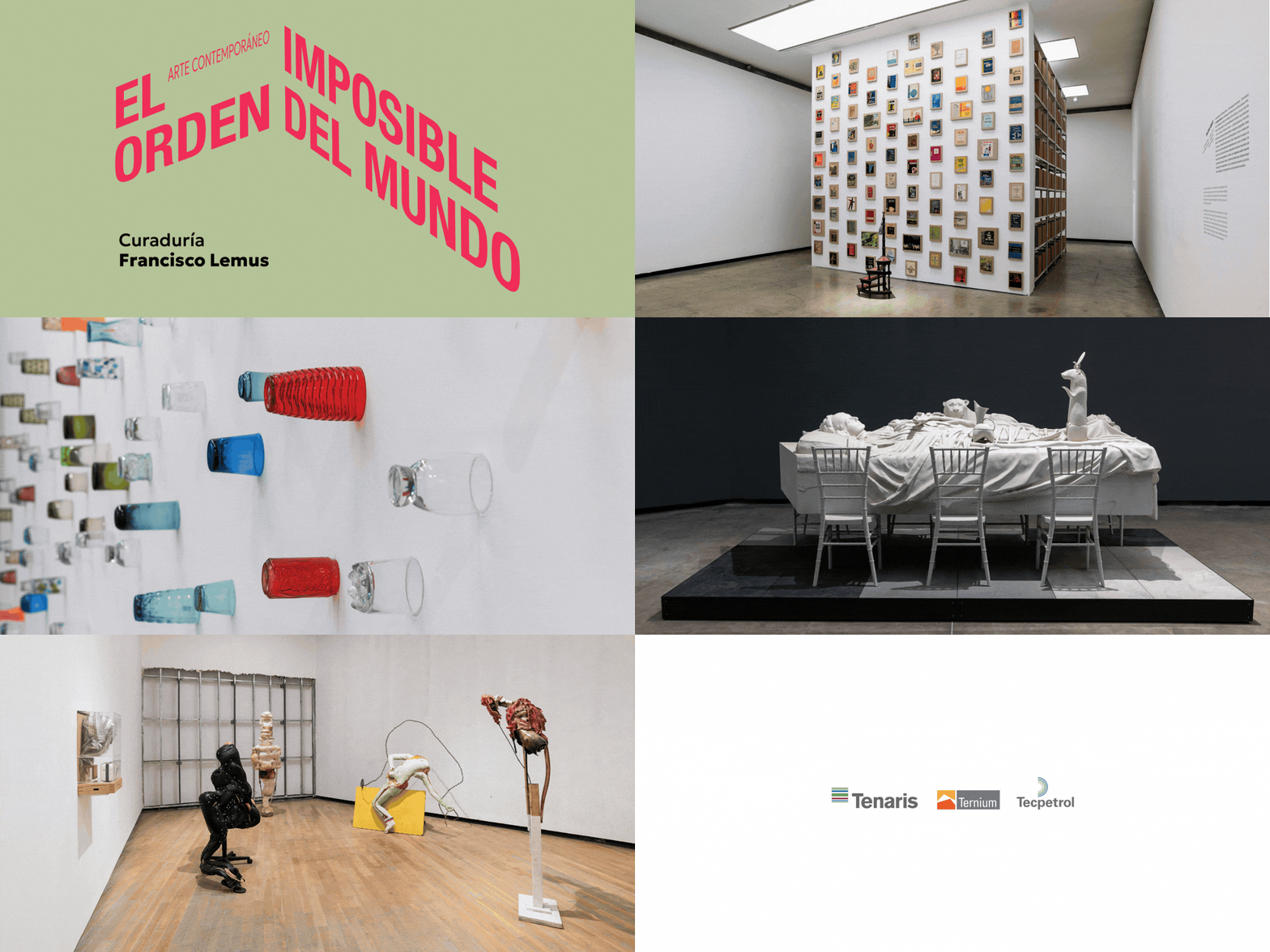
Starting Saturday, December 13, Fundación Proa presents The Impossible Order of the World. Contemporary Art, an exhibition curated by Francisco Lemus that brings together 26 artists of great vitality within today’s contemporary scene.
We might say that the “impossible order of the world” is precisely the starting point of contemporary art: a way of making visible the conflict between order and instability, where the contingent and the provisional do not seek to restore a lost coherence but to reveal the tension itself.
In a world saturated with images, Lemus proposes new relationships through a selection of works that, due to their monumental scale, occupy and reshape the space, asserting their presence in the face of contemporary volatility. In a context where nothing seems to endure, monumentality acts as a form of resistance against oblivion—as if each work declared: “If everything shifts, I remain here to signal it.”
The exhibition is conceived as a landscape in the Romantic sense, where the works function as elements of a constructed nature capable of momentarily withdrawing the viewer from the everyday and immersing them in an aesthetic dialogue that invites another mode of attention.
Each gallery proposes a thematic axis without limiting the possible interpretations. The first presents works by Martín Legón and Valeska Soares, focused on time and the archive—understood not as something fixed but as a space in motion that enables new readings of both past and present.
Rivane Neuenschwander’s installation—her “public barriers”—transforms the second gallery into an urban landscape, a kind of condensed city. In dialogue with it, the works of Amalia Pica, Elena Dahn, and Juane Odriozola incorporate gestures and everyday objects that introduce a subjective and intimate dimension into this environment, highlighting the tension between the urban and the personal. Together, these pieces shape a landscape of the everyday—of the small acts and signals that run through daily life.
The Theater of Disappearance was a monumental project created for the rooftop of the Metropolitan Museum of Art in New York in 2017. There, Adrián Villar Rojas worked with the museum’s collections—from Egyptian and Greek art to contemporary objects—to produce hybrid sculptures that mix bodies, fragments, utensils, and artifacts from different eras and cultures. The work directly reflects the idea of the “impossible order of the world,” showing how the fragments that make up our history and ways of seeing can be recombined in unexpected ways to create an imagined archaeological landscape. Acquired by the Balanz Collection, the ensemble is exhibited in its entirety for the first time in an exhibition space.
In the final gallery, artist Diego Bianchi was invited to design the curatorial approach and spatial arrangement. The decision stems from an interest in bringing two ways of seeing into dialogue: that of the curator, who structures relationships and proposes an interpretive framework, and that of the artist, who introduces a different sensibility capable of reorganizing the space through the logic of the studio. The coexistence of these perspectives generates a final landscape in which the display not only accompanies the works but proposes another way of reading and inhabiting them.
The exhibition’s conclusion distills the question that runs throughout: How can we look at a world that no longer responds to any stable order? Proa chose to work on this question because the narratives that once structured our experience—historical, political, aesthetic—are no longer sufficient. The Impossible Order of the World thus emerges as a kind of exercise: an attempt to make visible the instability that defines our time and, at the same moment, to show that new ways of thinking, connecting, and imagining also arise from within that instability. The different landscapes constructed across the galleries—the archival, the urban, the everyday, and the archaeological—do not close a narrative; they open possible scenes.
The curator’s research led him to identify points of encounter among artists and sensibilities that resonate with the tensions of the contemporary moment. He selected works that, due to their complexity, often remain outside the public eye. Many of them belong to the private collections of Balanz, Oxenford, and Cherñajovsky, and the exhibition includes the curatorial contribution of artist Diego Bianchi as well as newly created site-specific works.
We extend our special thanks to the lenders: Balanz Collection, J.K. Brown & Eric Diefenbach Collection, Cherñajovsky Collection, Oxenford Collection, and to the artists Diego Bianchi, Elena Dahn, Martín Legón, Rivane Neuenschwander, and Juane Odriozola.
The exhibition is sponsored by Tenaris – Ternium.
Organiza Curador Coordinación general
Fundación Proa
Francisco Lemus
Cecilia Jaime
Diseño Conservación Iluminación
Guillermo Goldschmidt
Diseño expositivo y montaje
Guadalupe Tagliabue
Pablo Zaefferer
Sala 4: Diego Bianchi
Soledad Oliva
Elena Romashova
Araceli Navarro (Estudio Adrián Villar Rojas)
Jorge Pastorino
Educación
Noemí Aira
Sonia Gugolj
Educadoras
Melina Herrero
Miranda Jacoby
Nur Nazur
Prensa
Ana Clara Giannini
Marina Gambier
Alba Rodríguez Arranz
Leandro Vento
Programas públicos
Rosario García Martínez
Chiara Alliata
Prestadores
Colección Balanz
Colección J.K. Brown & Eric Diefenbach
Colección Cherñajovsky
Colección Oxenford
y los artistas:
Diego Bianchi
Elena Dahn
Martín Legón
Rivane Neuenschwander
Juane Odriozola