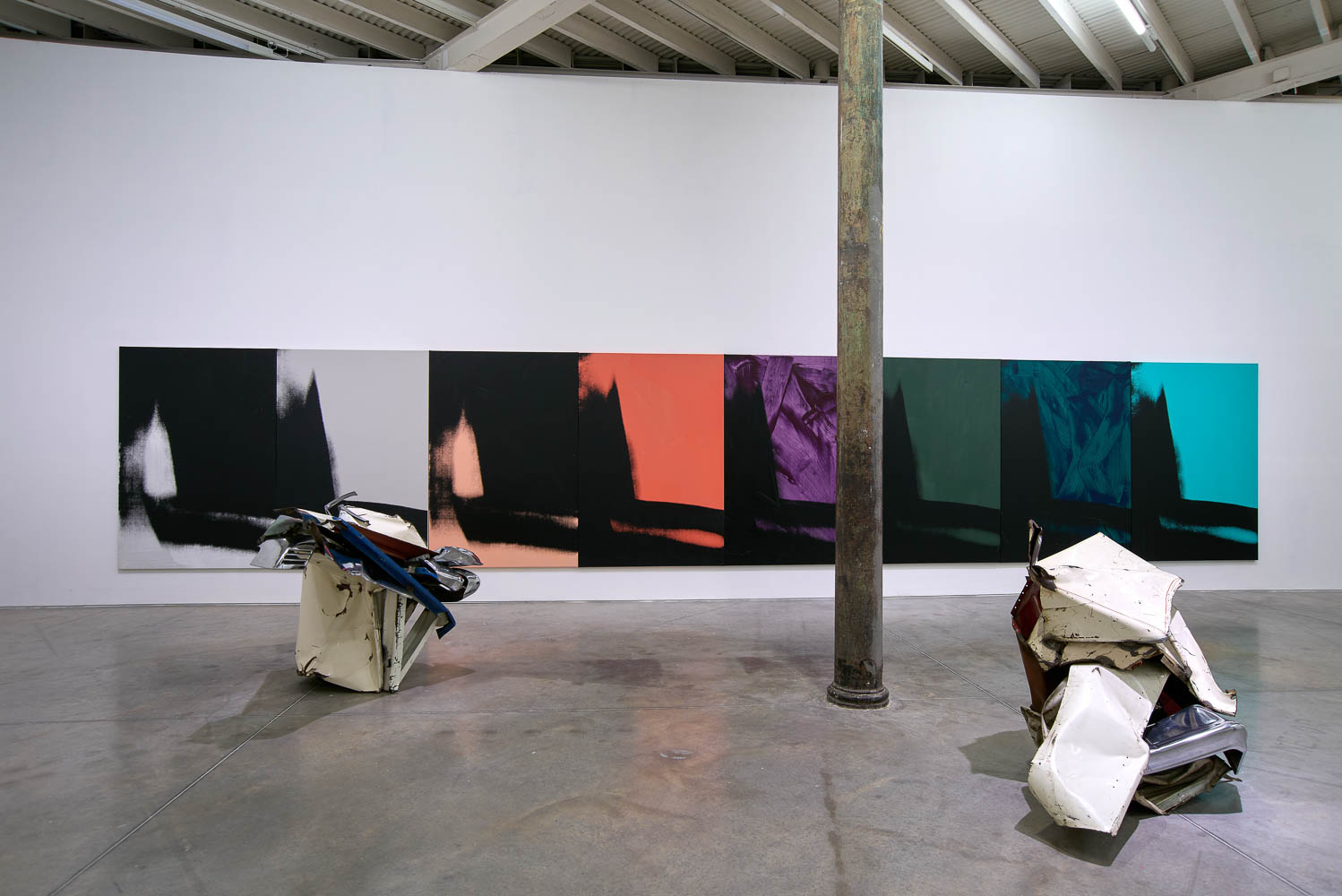
 Installation view of the exhibition “Penumbra: Dia Art Foundation” at Fundación Proa, 2026.
Curatorial Text Interview with Adriana Rosenberg
by Humberto Moro
by Proa’s Press Department
Curatorial Text:
Humberto Moro
Penumbra: Dia Art Foundation
Penumbra takes its title from the zone of partial shadow that exists between illumination and darkness—a threshold condition in which light is neither fully present nor fully withdrawn. A word and a concept that is nearly identical in over a dozen languages, penumbra names a space of perceptual uncertainty, hesitation, and suspension, where form loosens, edges blur and meaning resists completion. Within this conceptual framework, a selection of works from Dia’s collection by Walter De Maria, Félix González-Torres, Tehching Hsieh, Robert Irwin, Agnes Martin, Richard Serra, James Turrell, and Andy Warhol reflect key aspects of Dia’s history and mission, foregrounding conceptual and minimalist practices of the 1960s and 1970s and tracing their ongoing resonance into the present.
The works assembled in this exhibition approach light not as a vehicle of revelation or transcendence, but as a contingent force—one that is shaped, obstructed, absorbed, or diffused by bodies, materials, and spatial conditions. On view from March 27 to August 3, 2026, Penumbra marks the second collaboration between Dia Art Foundation and PROA, following the presentation of works by Dan Flavin in 1998, and continues a shared commitment to sustained, site-sensitive encounters with art.
Across postwar and contemporary practice, light has frequently functioned as a metaphor for clarity, immateriality, and access. Penumbra instead attends to light’s limits: to moments when illumination is interrupted, when visibility is slowed or destabilized, and when form emerges not through disclosure but through attenuation. In this context, light and shadow operate as reciprocal, active forces rather than oppositional terms, shaping perception through withholding as much as through presence.
Andy Warhol’s silkscreened-paintings Shadows (1978–79) anchors this inquiry through repetition and seriality, presenting shadow as both subject and surface. Visually removed from any discernible source photograph, the shadows appear as autonomous images—simultaneously graphic and indeterminate—oscillating between abstraction and representation. Their rhythmic sequence and chromatic variation deny a stable point of view, situating the viewer within a field of visual fluctuation rather than narrative coherence, which is further reinforced by Warhol’s concept to allow the paintings to be hung in any sequence.
James Turrell and Robert Irwin further complicate perception by working directly with light as a spatial and temporal medium. Turrell’s installations generate environments in which light appears tangible. Catso Blue (1967/87), produced as part of the artist’s Cross Corner Projections series, collapses distinctions between surface and volume and demands viewers to suspend conventional depth cues. Irwin’s investigations into conditions of “light and unlight”— Untitled (1965-67), Blue Jay (2018), and Pacific Jazz (2010), similarly engage states of reduced visibility, activating peripheral vision and heightening awareness of duration and bodily presence. In both practices, perception unfolds gradually, contingent upon time, movement, and attention.
Agnes Martin’s acrylic on canvas paintings from the Innocent Love series introduce a quieter, more introspective register of penumbra. Her finely calibrated grids and subtle tonal modulations operate at the edge of visibility, where structure approaches dissolution and repetition becomes meditative. Martin’s work demands sustained, disciplined looking, proposing an ethics of attention grounded in restraint and sensitivity rather than immediacy or spectacle.
Material weight and gravitational force enter the exhibition through works by Walter De Maria, Richard Serra, and John Chamberlain. De Maria’s Hardcore (1969) translates endurance, sound, and minimal action into a cinematic experience that confronts the viewer with time as both physical and opaque. Serra’s torque ellipse maquettes (1994-1998) register shadow as an effect of mass and curvature, where form asserts itself through pressure, rotation, and resistance. These maquettes, manually produced by Serra, are studies for and accompany the monumental steel sculptures that the artist realized at an architectural scale on view at Dia Beacon since 2003. Chamberlain’s compressed steel sculptures absorb and fracture light, producing dense, chromatic shadows that oscillate between violence and lyricism, collapse and exuberance. The artist’s gesture of compressing car parts is formally translated to his mineral-coated translucent resin sculptures, which refract and scatter a multi-hued spectrum of light.
The exhibition’s engagement with penumbra extends beyond material and perceptual concerns to include duration, exposure, and withdrawal. Tehching Hsieh’s Exposure (1973/2016), presented on film, documents a performance in which photographic paper is subjected to prolonged exposure, foregrounding time, process, and the irreversible effects of light. Félix González-Torres’s Untitled (Loverboy) (1989), an instruction piece realized as a translucent blue curtain installed over the institution’s windows in which it’s installed, subtly filters incoming light, transforming architecture into an instrument of attenuation and proposing opacity as both a visual and ethical condition.
Taken together, the works in Penumbra articulate a shared commitment to what remains unresolved—visually, spatially, and conceptually. Rather than framing shadow as a deficiency, the exhibition proposes penumbra as a productive state: one in which perception is sharpened through indeterminacy and meaning emerges through restraint. In an era increasingly shaped by demands for transparency, immediacy, and total visibility, Penumbra insists on the value of partial light, delayed perception, and the enduring presence of shadow.
Interview with Adriana Rosenberg by Proa’s Press Department
What does it mean for Proa to open its exhibition calendar with a show from Dia Art Foundation, and what place does it occupy within the 2026 program?
Our admiration for Dia Art Foundation goes back many years. From its beginnings, its work presenting a collection of works in which the viewer plays an active role in constructing the artistic experience created a strong affinity with Proa’s mission.
Our dialogue began when Michael Govan, then director of Dia Chelsea, curated the Dan Flavin exhibition at Proa, which was presented for the first time in Argentina. From that moment on, we maintained a continuous relationship of exchange and collaboration.
Opening our calendar with a selection of works from Dia is therefore a very meaningful gesture: it acknowledges the long-standing relationship between both institutions and allows us to present to local audiences a group of artists who are fundamental for understanding the transformations of contemporary art.
Considering Dia’s vast collection, how was the group of works and artists that will be presented in Proa’s galleries selected?
The initial premise was to select artists who had not been previously presented or widely seen in depth in our country. At Proa we always try, whenever possible, to organize exhibitions that have a historical dimension because they represent first presentations.
With the exception of Andy Warhol, whose work is already widely known, the group of artists brought together here is truly a privilege for Argentine audiences.
On this basis, curator Humberto Moro, together with Dia’s curatorial team, organized an exhibition that brings together artists and works in which light functions as a central element of the artistic experience.
The title of the exhibition introduces the notion of “penumbra.” How does this concept relate to the works presented?
The concept of penumbra, chosen by the curator as the overarching idea of the exhibition, refers to a zone of perception located between clarity and diffusion. It invites visitors to experience a visual and sensory journey that unfolds within this threshold.
Works by artists such as James Turrell, Robert Irwin, or Andy Warhol himself, with his Shadows series, present proposals in which light and shadow become fundamental materials.
In other works, light does not appear directly, yet the perceptual experience they propose equally refers to this idea of transition and visual ambiguity. The exhibition thus invites visitors to inhabit a space of introspective and sensory contemplation.
What is the historical importance of these works within contemporary art, and what concrete contributions did they make to its transformation since the 1960s?
Many of the works presented were commissioned, which is already a distinctive characteristic of Dia’s collection. This mode of production allowed artists to develop works conceived specifically for particular spaces and contexts.
The selection brings together pieces that marked important milestones in the history of contemporary art. Some are even being publicly presented for the first time despite being part of the collection.
These proposals emerged in the context of the profound artistic transformations of the 1960s and contributed to redefining fundamental notions such as contemplation, space, and time within aesthetic experience.
Artists such as Robert Irwin, James Turrell, and Dan Flavin shifted the focus from the art object toward experience and perception. The works are no longer limited to being observed; they exist in space to be walked through, perceived, and experienced by the viewer.
This shift also implied a transformation in the ways art is produced and circulated. Many of these works require long development periods, are conceived for specific contexts, and in many cases take the form of installations of a permanent nature.
What points of connection exist between Dia and Proa in terms of mission, scale of projects, and relationships with artists?
Following the Dan Flavin exhibition presented at Proa by Michael Govan, other projects emerged, such as the invitation to Sol LeWitt, who created a series of wall drawings that covered all the walls of our institution.
It was an extraordinary project, both because of its working methodology and because of the impact it had on the artists and assistants who participated in its realization. It was also remarkable for the ephemeral nature of the experience: the murals were conceived for that moment and were later destroyed.
This type of project reflects a deep affinity between both institutions in the way they work with artists and conceive the public’s experience.
How does this exhibition fit within Proa’s 30th anniversary program?
From its beginnings, Proa has sought to present in Buenos Aires some of the most relevant artistic movements of the twentieth century, working with artists and works of international significance.
The dialogue with Dia began almost in the early years of our foundation and has remained a constant line of interest and experimentation. Throughout our history we have organized exhibitions dedicated to minimalism, conceptual art, and other fundamental movements of contemporary art, both internationally and in relation to Argentine and Latin American artists.
In this sense, the exhibition naturally integrates into Proa’s history and its affinity with these artistic practices, which propose new ways of perceiving and inhabiting the world.
What impact do you hope this exhibition will have on the local artistic scene and on the dialogue between Argentina and the international circuit?
Proa’s exhibitions usually receive a very strong response, even when they may be challenging for audiences. We believe that our public programs—lectures, seminars, and educational activities—help expand the understanding of these works and enrich the content we offer to visitors.
In this case, the exhibition will be accompanied by a solid catalogue organized in sections dedicated to each artist. As is customary in our publications, it will include critical texts, statements by the artists themselves, and documentation of the works installed in our galleries.
AGNES MARTIN
BEAUTY IS THE MYSTERY OF LIFE
When I think of art I think of beauty. Beauty is the mystery of life. It is not in the eye it is in the mind. In our minds there is awareness of perfection. We respond to beauty with emotion. Beauty speaks a message to us. We are confused about this message because of distractions. Sometimes we even think that it is in the mail. The message is about different kinds of happiness and joy. Joy is most successfully represented in Beethoven's ninth Symphony and by the Parthenon. All art work is about beauty; all positive work represents it and celebrates it. All negative art protests tbe lack of beauty in our lives. When a beautiful rose dies beauty does not die because it is not really in the rose. Beauty is an awareness in the mind. It is a mental and emotional response that we make. We respond to life as though it were perfect. When we go into a forest we do not see the fallen rotting trees. We are inspired by a multitude of uprising trees. We even hear a silence when it is not really silent. When we see a newborn baby we say it is beautiful - perfect. The goal of life is happiness and to respond to life as though it were perfect is the way to happiness. It is also the way to positive art work. Jt is not in the role of an artist to worry about life - to feel responsible for creating a better world. This is a very serious distraction. All of your conditioning has been directed toward intellectual living. This is useless in art work. All human knowledge is useless in art work. Concepts, relationships, categories, classifications, deductions are distractions of mind that we wish to hold free for inspiration. There are two parts of the mind. The outer mind that records facts and the inner mind that says "yes" and "no". When you think of something that you should do the inner mind says "yes" and you feel elated. We call this inspiration.
LECTURE AT CORNELL UNIVERSITY
I want to talk to you about "the work", art work. I will speak of inspiration, the studjo, viewing art work, friends of art, and artists' temperaments. But your interest and mine is really "the work" - works of art. Art work is very important in the way that I will try to show when I speak about inspiration. I have sometimes put myself ahead of my work in my mind and have suffered in consequence. I thought me, me; and I suffered. I thought I was important. I was taught to think that. I was taught: "You are important; people are important beyond anything else." But thinking that I suffered very much. I thought that I was big and "the work" was small. It is not possible to go on that way. To think I am big is the work is big. The position of pride is not possible either. And to think I am small and the work is small, the position of modesty, is not possible. I will go on to inspiration and perhaps you will see what is possible. As I describe inspiration I do not want you to think I am speaking of religion. That which takes us by surprise - moments of happiness - that is inspiration. Inspiration which is different from daily care. Maoy people as adults are so startled by inspiration which is different from daily care that they think they are unique m having had it. Nothing could be further from the truth. Inspiration is there all the time. For everyone whose mind is not clouded over with thoughts whether they realize it or not. Most people have no realization whatever of the moments in which they are inspired.
(...)
Through simple geometry, Martin found, she could pursue a classical perfection that she described as absent from nature, held only in the mind. Using rectangles, squares, and grids of points and lines, she virtually dispensed with traditional notions of composition in painting. Even the inventors and heroes of abstraction, from Dutch artist Piet Mondrian and the Russian Kasimir Malevich to her own Abstract Expressionist contemporaries, had clung to the powerful dynamics of painterly composition. Martin's delicate rectangular grids of pencil lines, on the other hand, lightly echoing the weave of her square canvases, as in The Beach (1963) or The Peach (1964), border on the edge of being paintings at all. Merging the classical abstract ideal of Platonic geometry with an empty, egoless Taoist meditation, Martin dematerializes the canvas into a transparent, nonhierarchical field of vision, perhaps suggesting the experience (rather than the image) of the landscape of the Southwest desert.
Martin's recent paintings-epitomized by her 1999 Innocent Love series, made specifically for Dia-seem to emanate light rather than reflect it. Gently insistent horizontal lines suggest an infinite space beyond the serial grid of the eight five-foot-square canvases. The theme of innocent love may be related to the artist's descriptions of the "untroubled state of mind" (often referred to in her journals) that allows for "moments of inspiration," which "added together make what we call sensibility."4 Young children, innocent and untroubled, have many more inspirations than adults, Martin writes. She has also said that it was in thinking about the innocence of trees that she first considered the grid. A pure, abstract, egoless, untroubled state of mind is conveyed through these nearly immaterial works and through Martin's infinite vision.
ANDY WARHOL
"PAINTER HANGS OWN PAINTINGS"
On Tuesday I hung my painting(s) at the Heiner Friedrich gallery in SoHo. Really it's one painting with 83 parts. Each part is 52 inches by 76 inches and they are all sort of the same except for the colors. I called them 'Shadows' because they are based on a photo of a shadow in my office. It's a silk screen that I mop over with paint.
I started working on them a few years ago. I work seven days a week. But get the most done on weekends because during the week people keep coming by to talk.
The painting(s) can't be bought. The Lone Star Foundation is presenting them and they own them.
Someone asked me if they were art and I said no. You see, the opening party had disco. I guess that makes them disco decor.
This show will be like all the others. The review will be bad - my reviews always are. But the reviews of the party will be terrific.
I had the painting(s) hung at eye level. Any lower and people would kick them, especially at the party. The only problem with hanging the show was the gallery floor. One end of the gallery is a foot higher than the other.
But the kids helped me, and when we finished we all had lunch. l ate a pickle and drank some Evian and then some Perrier Jouet.
The gallery looked great. It's a simple, clean space. My Mao show was bigger, but this is the biggest show I've had ni New York City in a long time.
After we were finished, I took a walk with some friends. We stopped at Ivan Karp's gallery, O. K. Harris. He told me that there are a lot of people now doing shadows in art. I didn't know that.
Then we crossed the street and went into Holly Solomon's gallery. I like to see if the art across the street is always better than mine.
Andy Warhol, 1979. Warhol, A. (1979, 5 de febrero). Painter Hangs His Own Paintings. New York, vol. 12(6).
SHADOWS IN 1970s ABSTRACT ART IN THE UNITED STATES
REPETITION OF DOUBT
By Éric de Chassey, Director General of the French Institute for Art History
In Shadows, at the same time as [this decorative tendency], there is a true poetics of space and allusion, characteristic of the figurative tradition — especially in the individual paintings of the series of 102 canvases held by the Dia Art Foundation (and much less in the later Shadows, which are often flatter). A kind of reversal takes place here: in a certain way, in his earlier paintings abstraction was mainly in the background, that is to say in the space in which objects or people are located. As Warhol stated in 1975: “When I look at things, I always see the space they occupy. I always want the space to reappear, to make a comeback, because it’s a lost space when there’s something in it. If I see a chair in a beautiful space, no matter how beautiful the chair is, it can never be as beautiful as the plain space.” In Shadows, space (the corner of a wall, visible in the diagonal lines) constitutes a three-dimensional thing whereas the “objects” of painting (shadows) are abstract. They are all the more abstract in that, at least that is what the title of the series suggests to the visitor, they refer to objects outside the field of the canvas, exactly what objects we probably will never know (they are neither in the same space nor the same time as the canvas). This is the case despite the recent discovery and publication of photographs taken by the artist’s assistants, Kevin Ryan and Ronnie Cutrone, which provide a purely technical source for the images but do not reveal the source of the shadows.
Many stories have circulated about the nature of these objects, sometimes claimed to be the shadows of a penis and sometimes of cardboard constructions made on the spot in a corner of the studio, in the manner of the techniques used by Czech abstract photographers from the 1920s and 1930s (such as Jaromir Funke and František Drtikol). Without even knowing these stories, when one looks at Warhol’s Shadows — or when one is surrounded by them — one feels, confusedly at least, the presence of a mystery. As the painter Julian Schnabel pointed out in 1989, “they are as full of imagery as any of Andy’s other paintings.”¹⁴ The difference with the rest of Warhol’s paintings, however, is that while we feel clearly that these are images, we don’t know what they are exactly or what they represent precisely. All that remains is the shadow of something that is no more or is no longer there, both an emergence and a disappearance, the shadow of life, extending abstractly here, the shadow of death and/or the shadow of life extending, abstractly there, the way in which, in some paintings in the Skulls series of 1976, the shadow of the skull evokes the shape of a newborn’s head.
de Chassey É. (2016). Shadows en el arte abstracto de los años setenta en Estados Unidos. Repetición de la duda en BeauxArts éditions Andy Warhol Shadows, Yus Museum Shanghai, 16-17.