PRESENTATION
“Penumbra: Dia Art Foundation”
Opening: Saturday, March 28, 2026 – August 2, 2026
Organized by: Dia Art Foundation – Fundación Proa
Curated by: Humberto Moro (Deputy Director of Program) – Ella den Elzen (Curatorial Assistant)
Sponsored by: Tenaris – Ternium
Agnes Martin - Andy Warhol - Felix Gonzalez-Torres - James Turrell - John Chamberlain - Richard Serra Robert Irwin - Tehching Hsieh - Walter De Maria
We are presented with “Penumbra: Dia Art Foundation,” a historic exhibition that brings together, for the first time in Argentina, fundamental artists of contemporary art who have never before been exhibited in the country. The exhibition constitutes a milestone in Proa’s program and a major event for the local and regional art scene. In 1998, Fundación Proa and Dia Art Foundation presented the first major exhibition of Dan Flavin in Buenos Aires, followed by the wall drawings of Sol LeWitt.
Those unforgettable experiences marked a decisive moment: they not only introduced extraordinary artists previously unseen in the local scene, but also represented a fundamental institutional recognition in Proa’s early years. The support of Dia opened new possibilities, projecting the Foundation into the international sphere and establishing a working model that expanded its horizons. Today, almost thirty years later, and on the eve of Proa’s 30th anniversary, we revisit that relationship to once again present key artists in the history of art from the second half of the twentieth century.
Curated by Humberto Moro, with curatorial assistance by Ella den Elzen, the exhibition is organized around a central idea: penumbra as experience. It is not simply a condition of light, but an intermediate state, a threshold where perception becomes unstable and the work ceases to assert itself as an object, instead unfolding in relation to space, time, and the presence of the viewer. In this sense, the practices brought together in the exhibition share a decisive transformation in the history of art: the shift from the artwork as an autonomous form to the artwork as a situation. Matter—whether steel, light, or image—is presented not as representation but as presence. Space ceases to be a neutral support and becomes a constitutive part of the work, and the viewer becomes an active agent whose experience completes what takes place.
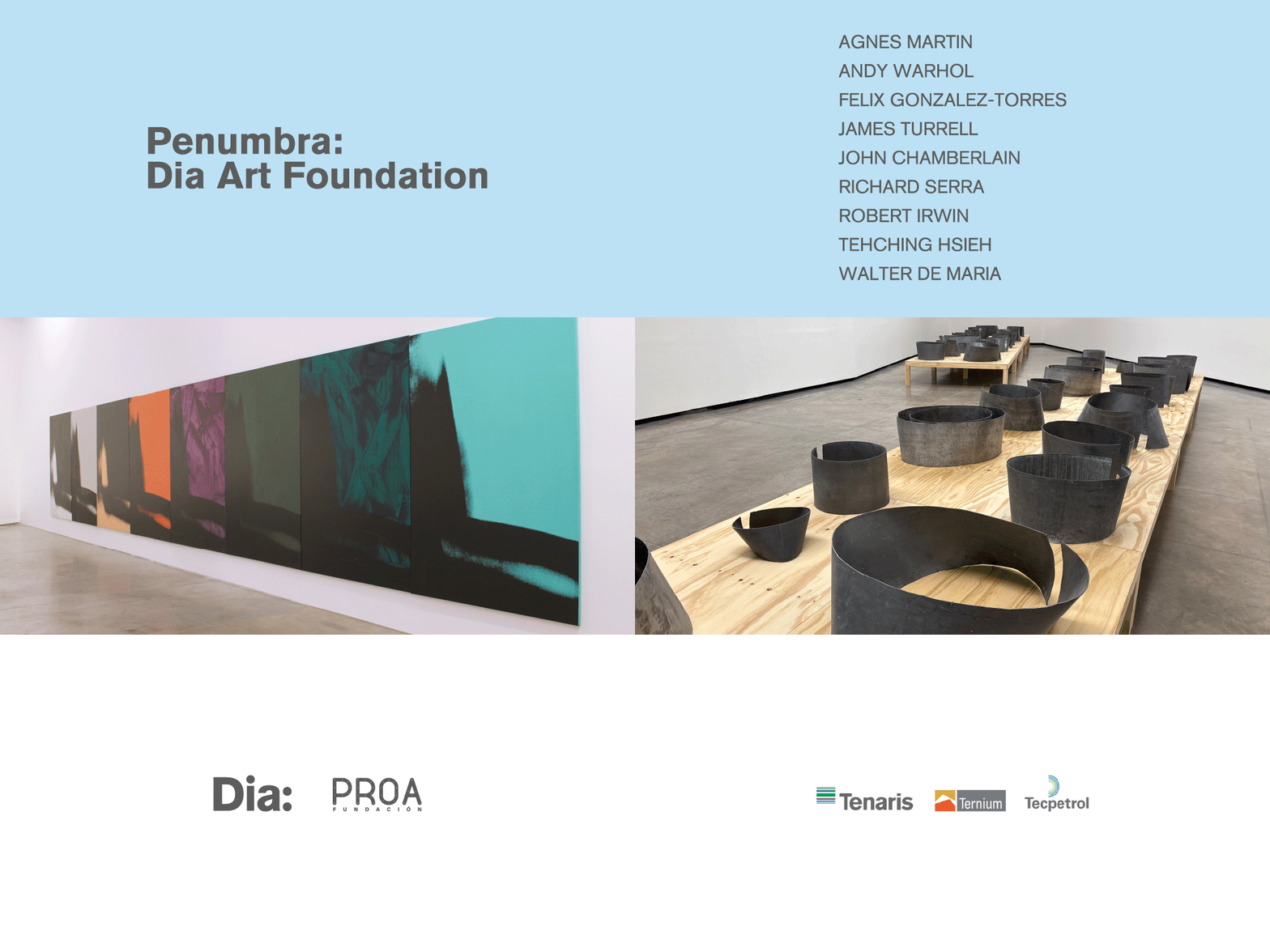
The works brought together at Proa allow for an appreciation of moments of great intensity in each artist’s trajectory. In Andy Warhol, Shadows—his large “penumbras”—unfolds as a monumental, almost abstract pictorial sequence. Richard Serra’s investigations in steel explore weight, tension, and balance, while in James Turrell light becomes substance. In the work of Robert Irwin and in the curtains of Felix Gonzalez-Torres, light and the passage of time alter the experience: nothing is fixed; everything depends on duration and movement through space. In the case of Gonzalez-Torres, the curtains—traversed by natural light—fill the space with a shifting tonality that changes throughout the day, transforming the interior and making the passage of time visible. The work does not impose itself: it happens. By contrast, in the almost imperceptible surfaces of Agnes Martin, repetition and delicacy invite a sustained form of contemplation, akin to meditation.
As Moro notes, these works converge on a shared question: how we look and how we inhabit space. In this journey, penumbra ceases to be a condition of light and becomes a field of perception: a territory where the visible and the hidden are held in tension, where the gaze adjusts and becomes aware of itself, and where each experience occurs in the present, in a unique and unrepeatable way.
Fundación Proa expresses its special recognition to Tenaris – Ternium and to American Friends of Fundación Proa for their sustained commitment to cultural development and for making this exhibition possible. It also extends its deep gratitude to the teams of Dia Art Foundation and Fundación Proa, whose joint, rigorous, and committed work has been essential in bringing this project to fruition.
Curatorial Text:
Humberto Moro
Penumbra: Dia Art Foundation
Penumbra takes its title from the zone of partial shadow that exists between illumination and darkness—a threshold condition in which light is neither fully present nor fully withdrawn. A word and a concept that is nearly identical in over a dozen languages, penumbra names a space of perceptual uncertainty, hesitation, and suspension, where form loosens, edges blur and meaning resists completion. Within this conceptual framework, a selection of works from Dia’s collection by Walter De Maria, Félix González-Torres, Tehching Hsieh, Robert Irwin, Agnes Martin, Richard Serra, James Turrell, and Andy Warhol reflect key aspects of Dia’s history and mission, foregrounding conceptual and minimalist practices of the 1960s and 1970s and tracing their ongoing resonance into the present.
The works assembled in this exhibition approach light not as a vehicle of revelation or transcendence, but as a contingent force—one that is shaped, obstructed, absorbed, or diffused by bodies, materials, and spatial conditions. On view from March 27 to August 3, 2026, Penumbra marks the second collaboration between Dia Art Foundation and PROA, following the presentation of works by Dan Flavin in 1998, and continues a shared commitment to sustained, site-sensitive encounters with art.
Across postwar and contemporary practice, light has frequently functioned as a metaphor for clarity, immateriality, and access. Penumbra instead attends to light’s limits: to moments when illumination is interrupted, when visibility is slowed or destabilized, and when form emerges not through disclosure but through attenuation. In this context, light and shadow operate as reciprocal, active forces rather than oppositional terms, shaping perception through withholding as much as through presence.
Andy Warhol’s silkscreened-paintings Shadows (1978–79) anchors this inquiry through repetition and seriality, presenting shadow as both subject and surface. Visually removed from any discernible source photograph, the shadows appear as autonomous images—simultaneously graphic and indeterminate—oscillating between abstraction and representation. Their rhythmic sequence and chromatic variation deny a stable point of view, situating the viewer within a field of visual fluctuation rather than narrative coherence, which is further reinforced by Warhol’s concept to allow the paintings to be hung in any sequence.
James Turrell and Robert Irwin further complicate perception by working directly with light as a spatial and temporal medium. Turrell’s installations generate environments in which light appears tangible. Catso Blue (1967/87), produced as part of the artist’s Cross Corner Projections series, collapses distinctions between surface and volume and demands viewers to suspend conventional depth cues. Irwin’s investigations into conditions of “light and unlight”— Untitled (1965-67), Blue Jay (2018), and Pacific Jazz (2010), similarly engage states of reduced visibility, activating peripheral vision and heightening awareness of duration and bodily presence. In both practices, perception unfolds gradually, contingent upon time, movement, and attention.
Agnes Martin’s acrylic on canvas paintings from the Innocent Love series introduce a quieter, more introspective register of penumbra. Her finely calibrated grids and subtle tonal modulations operate at the edge of visibility, where structure approaches dissolution and repetition becomes meditative. Martin’s work demands sustained, disciplined looking, proposing an ethics of attention grounded in restraint and sensitivity rather than immediacy or spectacle.
Material weight and gravitational force enter the exhibition through works by Walter De Maria, Richard Serra, and John Chamberlain. De Maria’s Hardcore (1969) translates endurance, sound, and minimal action into a cinematic experience that confronts the viewer with time as both physical and opaque. Serra’s torque ellipse maquettes (1994-1998) register shadow as an effect of mass and curvature, where form asserts itself through pressure, rotation, and resistance. These maquettes, manually produced by Serra, are studies for and accompany the monumental steel sculptures that the artist realized at an architectural scale on view at Dia Beacon since 2003. Chamberlain’s compressed steel sculptures absorb and fracture light, producing dense, chromatic shadows that oscillate between violence and lyricism, collapse and exuberance. The artist’s gesture of compressing car parts is formally translated to his mineral-coated translucent resin sculptures, which refract and scatter a multi-hued spectrum of light.
The exhibition’s engagement with penumbra extends beyond material and perceptual concerns to include duration, exposure, and withdrawal. Tehching Hsieh’s Exposure (1973/2016), presented on film, documents a performance in which photographic paper is subjected to prolonged exposure, foregrounding time, process, and the irreversible effects of light. Félix González-Torres’s Untitled (Loverboy) (1989), an instruction piece realized as a translucent blue curtain installed over the institution’s windows in which it’s installed, subtly filters incoming light, transforming architecture into an instrument of attenuation and proposing opacity as both a visual and ethical condition.
Taken together, the works in Penumbra articulate a shared commitment to what remains unresolved—visually, spatially, and conceptually. Rather than framing shadow as a deficiency, the exhibition proposes penumbra as a productive state: one in which perception is sharpened through indeterminacy and meaning emerges through restraint. In an era increasingly shaped by demands for transparency, immediacy, and total visibility, Penumbra insists on the value of partial light, delayed perception, and the enduring presence of shadow.
Artists
Agnes Martin
Andy Warhol
Felix Gonzalez-Torres
James Turrell
John Chamberlain
Richard Serra
Robert Irwin
Tehching Hsieh
Walter De Maria
Organization Curator Curatorial Assistance General Coordination
Dia, New York
Fundación Proa, Buenos Aires
Humberto Moro
Ella den Elzen
Mayra Zolezzi
Image Design Conservation Design and Installation Lighting
Guillermo Goldschmidt
Julia Bozzalla
Elizabeth Peck
Soledad Oliva
Pablo Zaefferer
Guadalupe Tagliabue
Jorge Pastorino
Press Public Programs Educators
Marina Gambier
Ana Clara Giannini
Alba Rodríguez Arranz
Leandro Vento
Rosario García Martínez
Chiara Alliata
Education
Noemi Aira
Sonia Gugolj
Melina Herrero
Miranda Jacoby
Nur Nazur

Dia Art Foundation team
Jessica Morgan
Humberto Moro
Ella den Elzen
John Sprague
Elizabeth Peck
Randy Gibson
Alexis Pennington Foster
Curtis Harvey